
Published by Top Rides Truck Repair · 9640 Sidney Hayes Rd, Orlando, FL 32824 · (407) 591-6747
If you searched “truck repair shops near me” while sitting in a Pilot parking lot off I-4, you already know the problem. Google Maps spits out fifteen shops. Half are general auto places that took one truck on a Tuesday in 2019. Two are mobile-only and won’t have a bay open until tomorrow. Three have 4.9 stars from twelve reviews, which usually means they do oil changes for Camrys and someone’s wife rated them high.
You don’t have time for that. You’re losing money sitting still, and the wrong shop will keep you sitting still for another two days.
Here’s how a real diesel mechanic decides which Orlando truck repair shop is worth driving to. We’ve been on the other side of this. We’ve sent friends to competitors when our bays were full. We’ve gotten calls from drivers whose previous shop missed the actual problem. The patterns are pretty consistent.
Skip any shop that also advertises oil changes for sedans
The fastest way to filter the list is to look at what else they work on. If a shop’s homepage talks about brake pads for SUVs and synthetic blends for $59, the trucks are a sideline. They might do them. The owner’s son might even be decent at it. But the parts inventory, the diagnostic software, and the lifts are all set up for the cars in the next bay over.
Heavy-duty diesel is its own thing. The fault codes are different. The torque specs are different. Service intervals run in hundreds of thousands of miles instead of thousands. A shop that splits its attention will have to order half the parts you need and won’t have the OEM software to clear codes after the repair.
At Top Rides we don’t do light vehicles at all. Trucks over 14,000 lbs only. That’s not bragging. It’s a filter that saves you a phone call. If your search includes “diesel truck repair near me” or “commercial truck repair Orlando FL,” you want a shop that turns down easy money on sedans because the heavy-duty work pays better when it’s done right.
Check whether they have OEM diagnostic software for your truck
This is the test most drivers don’t think to apply, and it’s the one that tells you the most.
Modern semis don’t tell you what’s wrong by symptom. The truck’s computer knows. To get the truck to talk, the shop needs the manufacturer’s actual diagnostic software, not a generic OBD scanner. Cummins runs INSITE. Detroit runs DDDL (Diagnostic Link). PACCAR uses Davie4. Volvo has Tech Tool. Mack uses Premium Tech Tool. International runs ServiceMaxx.
A shop that owns one of these has spent thousands of dollars on the license. A shop that owns all of them is serious about diesel. Ask. Just ask. “What software do you run for a Cascadia?” If they hesitate or say “we have a scanner that works on everything,” that’s your answer. Good shops will rattle the names off without thinking. We run all the major ones because we don’t want to send a Volvo customer down the road when their I-Shift throws a code we can’t pull. If you want the deeper version of why this matters, pop over to our computer diagnostics page.
Look at the actual reviews, not the star count
A 4.9 from 22 reviews can be a wedding photographer with a side gig. A 4.3 from 200 reviews from named fleet customers is a real shop with a few bad days on record.
When you read truck shop reviews, look for these patterns. Real reviews mention specific trucks (“my 2019 Cascadia,” “Volvo VNL”). Real reviews mention specific repairs (“they fixed my EGR derate,” “kingpin replacement on the trailer”). Real reviews mention names of mechanics or service writers. Generic five-star reviews like “great service, fast” are useless. They could be from anyone, including the owner’s cousin.
Watch the one-star reviews too. Every shop has them. The question is what the shop says back. A defensive owner who blames the customer in every reply is a red flag. An owner who says “we missed that, here’s what we did differently after” is the kind of shop that learns from mistakes.
Get the quote in writing before any wrench moves
This one’s not negotiable. Any shop that won’t put the quote in writing, with line items for parts, line items for labor, and the diagnostic charge spelled out, is a shop that wants room to add things later.
Diesel work is expensive enough without surprise charges. A real diagnostic at a heavy-duty shop in Orlando runs around $150. DPF cleaning runs $400 to $650 depending on the unit and how clogged it is. A full in-frame engine rebuild is in five figures and shouldn’t be quoted over the phone. Anyone giving you a number sight-unseen is either making it up or has no intention of honoring it.
We quote everything in writing. If we open something up and find a tie rod is also worn, which happens, especially during an alignment job where the steering linkage is right there, we stop, call you, and re-quote before doing the additional work. Not a customer-service flourish. It’s just the only way the math works out for everyone.
Ask about turnaround time, then add a day
Every truck shop will tell you they can have you back on the road quickly. Ask the specific question: “If I drop it off Monday morning, when can I realistically pick it up?”
A shop that says “same day” for an engine rebuild is lying or doesn’t understand what you’re asking. A shop that says “we’ll let you know once we get into it” is being honest but not helpful. The right answer sounds like this: “Most front-end alignments are 2 hours, full 3-axle is 3 to 4 hours. Engine work depends on what we find. Usually one to three days for common stuff like injectors or EGR, longer if we have to in-frame it.”
Then add a day to whatever they say. Parts get backordered. The wrong gasket shows up. Things happen. A shop that builds in a buffer is being realistic. A shop that promises a tight turnaround is setting up a disappointment.
Check the bay before you commit
If you have time, drive by. You can tell more from a five-minute look at a shop’s parking lot than from twenty minutes on their website.
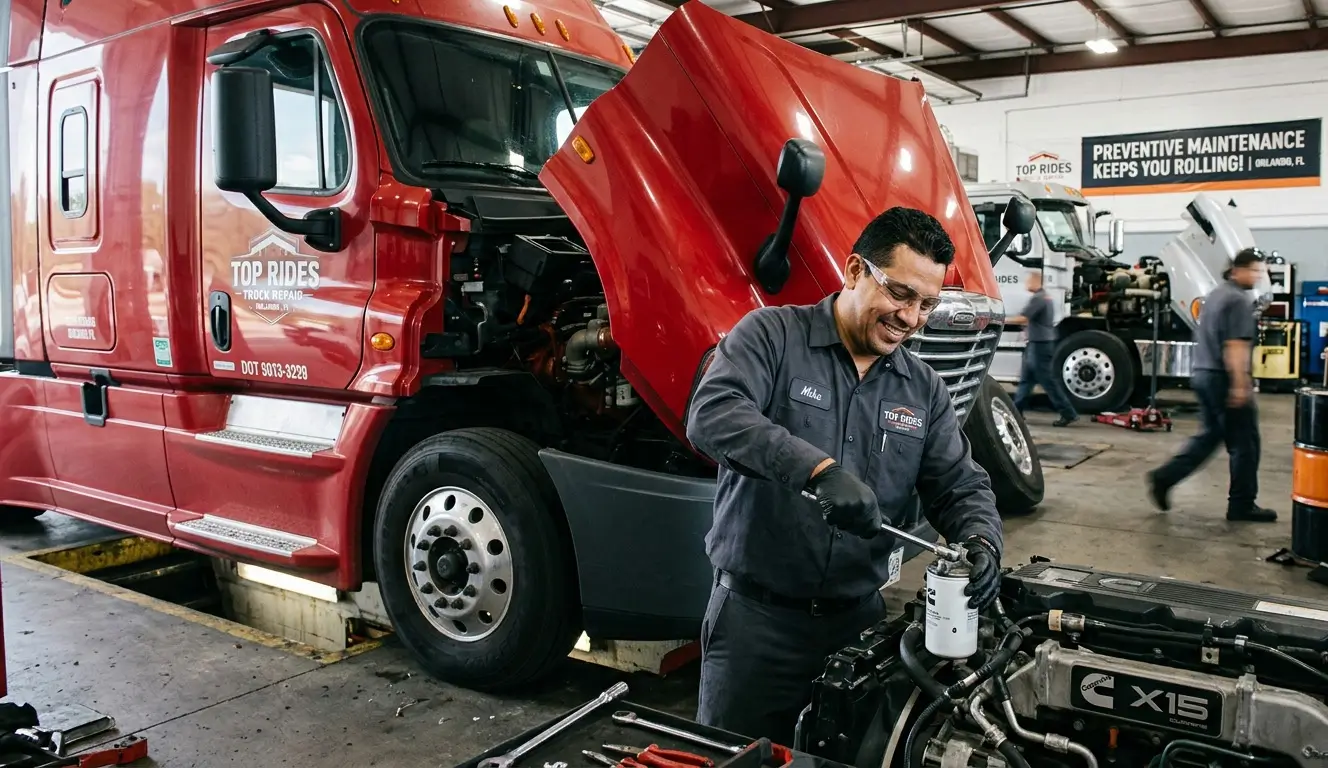
What you want to see: trucks on lifts (not sitting outside in pieces for weeks), organized parts shelves, mechanics in clean uniforms, a Hunter or similar serious alignment rig if they advertise alignments, and tools that match the work. What you don’t want to see: a single oil-change bay with a semi parked diagonally because nothing else fits, three trucks abandoned in the corner of the lot with weeds growing through the wheels, or a “we’ll be right back” sign on the front door at 11am Tuesday.
The Federal Motor Carrier Safety Administration’s SAFER system lets you look up any commercial trucking-related business and see whether they’ve had safety violations or are in good standing. Useful for vetting shops that offer towing or roadside service since those operations require their own DOT authority.
Understand the difference between mobile and shop work
Mobile truck repair is good for some things. Flat tires. A loose air line you can hear hissing. A starter swap if the truck is sitting at the customer’s dock and you can’t move it. Some jobs make sense to do at the side of the road.
Some jobs don’t. Alignments need a four-post lift and laser equipment that won’t fit in a service truck. Real engine work needs a clean bay, a parts washer, and torque tools that aren’t bouncing around in a toolbox. Brake jobs need the truck properly chocked and lifted, not on jack stands in gravel.
A shop that pushes mobile for everything is one to be careful with. Some jobs need to come in. We run 24/7 roadside service for the things that genuinely belong on the road, and we tow into the bay for everything else, even when the customer would rather have it done in the lot.
What to ask before you hand over the keys
A short list of questions that filter most of the bad shops out:
What OEM diagnostic software do you have for my truck? Do you have flat-rate or hourly labor, and what’s the rate? What’s your diagnostic charge? Can I get the quote in writing before work starts? Do you do warranty repairs and is there a labor warranty on what you fix? Do you have flat-rate fleet pricing if I bring more trucks? What’s a realistic timeline?
If a shop answers all of those without dancing around any of them, you’ve probably found a real one. If they get squirrely on price, timeline, or what software they actually own, keep looking.
Where Top Rides fits in this
We’re at 9640 Sidney Hayes Rd, just off the 417 and minutes from the Florida Turnpike. ASE-certified mechanics, all the major OEM software, a Hunter Heavy-Duty alignment lift, and we work on Volvo, Freightliner, Kenworth, Peterbilt, Mack, International, Western Star, and Isuzu. We do engine repair, transmission work, trailer repair, DPF cleaning, suspension, brakes, AC, welding — most of what comes through a heavy-duty bay door. Bilingual (English and Russian). Flat-rate pricing in writing. Most repairs same-day or next-day. Fleet accounts get priority scheduling and net-30 terms.
Whether you pick us or somebody else, apply the filters in this article. The Orlando metro has good shops and bad shops, and the difference between them isn’t subtle once you know what to look for.
Call (407) 591-6747 if you want to talk through whatever’s going on with your truck. We’ll tell you straight whether it’s something we should look at, or whether we’d send you somewhere else.