
Published by Top Rides Truck Repair · 9640 Sidney Hayes Rd, Orlando, FL 32824 · (407) 591-6747
You probably don’t ask a mechanic for his certifications before he opens the hood. Most owner-operators don’t. You ask for a price, a turnaround time, and whether he’s seen this problem before. Then you hand over the keys and hope.
But here’s the part nobody tells you when you’re on the side of I-4 with a check-engine light and a load that’s already late: the difference between an ASE-certified diesel technician and an uncertified one will often show up on the invoice. Sometimes by a few hundred dollars. Sometimes by a few thousand. And not always in the direction you’d think.
We’ve been running Top Rides Truck Repair in Orlando long enough to see both sides of this. So let’s get into what ASE certification actually is, what it isn’t, and how it changes the number at the bottom of your repair bill.
What ASE certification actually is
ASE stands for the National Institute for Automotive Service Excellence. It’s a non-profit that runs the standardized testing program most reputable shops in the U.S. use to credential their technicians. For heavy-duty trucks, the relevant tests are the T-Series — T1 through T8 — covering everything from diesel engines (T2) to brakes (T4) to preventive maintenance inspection (T8). A technician who passes T2 through T8 earns the title of ASE Certified Master Medium/Heavy Truck Technician.
You can read the full breakdown of the T-Series on the ASE official site.
A few things worth knowing:
- The tests are not easy. T2 (diesel engines) alone covers cylinder head diagnosis, fuel systems, electronic engine controls, and air induction. Plenty of working mechanics fail it the first time.
- A tech has to have two years of hands-on experience (or one year plus a degree) before ASE will even certify them.
- Certifications expire every five years. So an ASE patch on someone’s sleeve from 2014 doesn’t mean anything in 2026 unless they re-tested.
That last point trips up a lot of fleet managers. A “certified” shop that hasn’t recertified its techs in a decade is, on paper, no different from an uncertified one.
Why this shows up on your invoice
Here’s where it gets practical. There are four real-world ways certification changes what you pay.
1. Diagnostic time
This is the big one. A non-certified mechanic and a certified one will often quote you the same hourly rate — somewhere between $130 and $175 in the Orlando market right now. The difference is how many of those hours they bill you.
We had a truck come in last spring — a 2019 Cascadia with an intermittent EGR fault. The owner had already paid another shop $1,400 for two days of diagnostic time. They’d replaced the EGR valve. Problem came back the next week.
Our T2-certified tech traced it to a cracked clamp on the EGR cooler line in about ninety minutes. Fifty-dollar part. The previous shop wasn’t dishonest. They just didn’t know where to look.
That’s what certification buys you on the diagnostic side — somebody who’s been tested on knowing where to look. We wrote more about how we use this approach in our breakdown of multi-point inspections and hidden issues.
2. Comeback rate
A “comeback” is when the same truck rolls back into the shop for the same problem. Industry data is messy on this, but shops that track it internally typically see comeback rates of 8–15% with uncertified techs and 2–5% with ASE Master techs.
Now multiply that across your fleet. If you’re running ten trucks and your shop has a 12% comeback rate, that’s more than one truck a year coming back for a repair you already paid for. The hourly rate looked cheap. The total wasn’t.
3. Parts decisions
Certified diesel techs tend to be more conservative about replacing parts. A non-certified mechanic who’s not sure if a turbo is bad will often just replace the turbo. It’s easier than testing it.
A certified tech who’s passed T2 is going to do an actuator test, check boost pressure, verify the wastegate, and pull live data from the ECM before condemning a $3,800 unit. Same outcome if the turbo is actually bad. Very different outcome if it isn’t.
4. Warranty work and fleet contracts
If you’re running under a Daimler, PACCAR, or Volvo extended warranty, a lot of the fine print requires that diagnostic work be performed by an ASE-certified technician for the claim to be honored. Same for most large fleet contracts with national carriers. Hand the keys to an uncertified shop and you can technically void coverage on a $15,000 engine claim.
This catches owner-operators by surprise constantly. The shop doesn’t tell you. The warranty company finds out at claim time.
When non-certified is actually fine
I’m not going to pretend certification is everything. There are excellent diesel mechanics in Orlando who never got around to taking the ASE tests. Some of them have been wrenching on Cummins ISX engines since before half the certified techs were born.
For routine work — an oil change, a tire rotation, a DOT inspection — you probably do not need a master-level tech. You need someone competent and a shop with the right tools. Paying ASE Master rates for an oil change is silly.
The line for me is diagnostic complexity. The minute the problem becomes “we’re not sure what’s wrong” instead of “we know what needs to be replaced,” certification starts mattering a lot. That’s where the bill blows up on uncertified work.
This is part of why we recommend that owner-operators think carefully about the choice between local diesel shops and national chains — both have certified and uncertified people on staff, and the patch on the wall doesn’t always match what’s actually under the hood.
How to actually check before you drop your truck off
Don’t trust the sign on the building. Three quick checks that take you about five minutes:
- Ask which technician will be working on your truck and what their current ASE certifications are. Not the shop’s certifications. The individual tech’s. A good shop will tell you without hesitation.
- Ask when they last recertified. Five-year expiration is real. If the answer is “uh, a while back,” you have your answer.
- Check the ASE Blue Seal directory for shops where at least 75% of the technician staff is certified. We’re listed. Plenty of good shops in Orlando aren’t, and that’s fine — but the directory is one more datapoint.
What this looks like at our shop
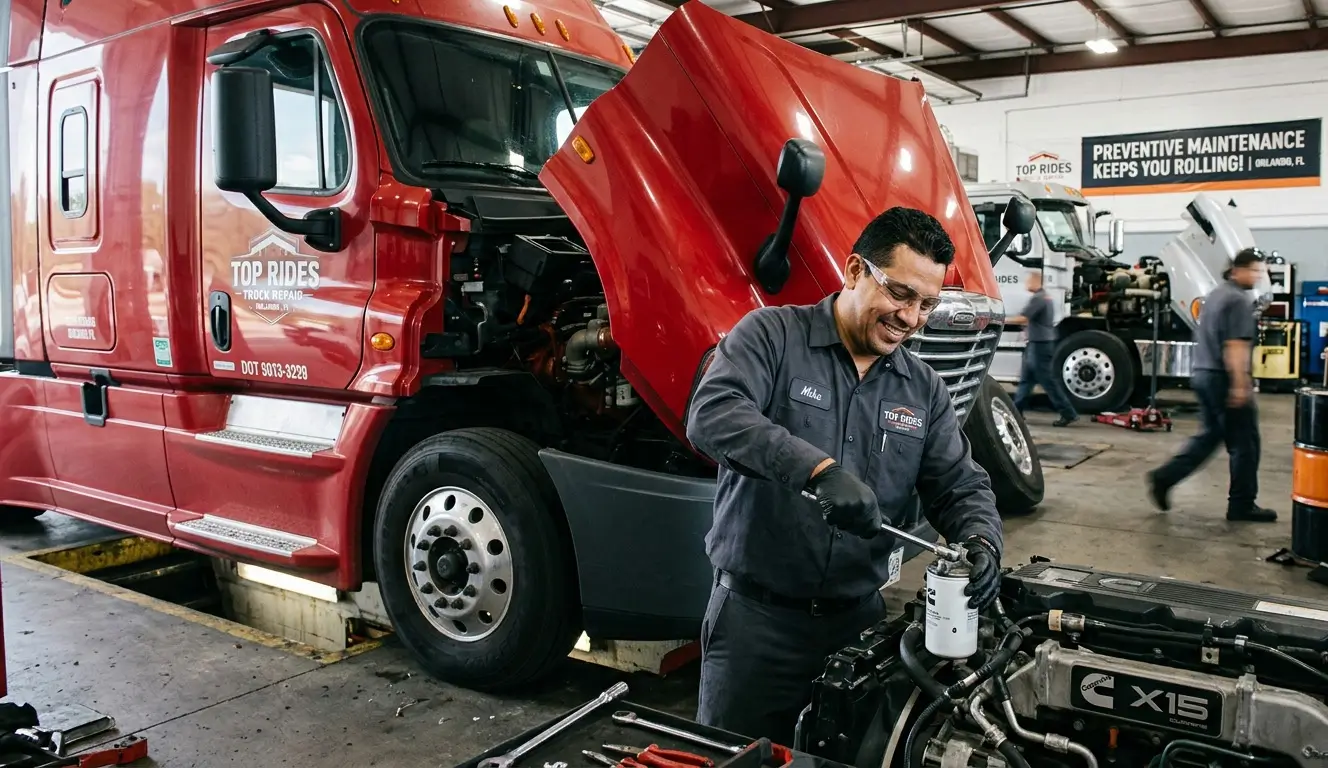
At Top Rides, our diesel techs hold current ASE certifications across the T-Series, with most of our diagnostic team carrying T2 (diesel engines), T4 (brakes), T6 (electrical), and T8 (preventive maintenance inspection). Two of our senior techs are ASE Certified Master Medium/Heavy Truck Technicians.
We mention this not to flex. We mention it because we’d rather you ask us about it than assume.
If you’re trying to figure out whether your shop’s pricing is reasonable, our breakdown on how to pick a truck repair shop near you in Orlando walks through the questions to ask before you commit. And if you’re a fleet manager thinking about long-term costs, the math in our preventive maintenance ROI piece makes the case that certified PM work pays for itself inside the first year on most fleets.
The honest summary
ASE certification does not guarantee a perfect repair. There are certified techs who are mediocre and uncertified techs who are excellent. But on average, across thousands of repairs, ASE-certified diesel mechanics produce fewer comebacks, faster diagnostics, more conservative parts decisions, and warranty-eligible work.
For a single $200 brake job, the difference is probably zero. For a $4,000 engine diagnostic, the difference can be the whole bill.
If you’re an owner-operator in Orlando and you’re not sure where your last shop falls on this spectrum, swing by and ask. We’ll show you the certifications. We’ll show you the diagnostic equipment. And if your problem is something we can fix while you wait, we’d rather do that than have you back next week for the same thing.
Top Rides Truck Repair 9640 Sidney Hayes Rd, Orlando, FL 32824 (407) 591-6747 topridesrepair.com Hours: Monday–Friday, 8 AM – 6 PM