
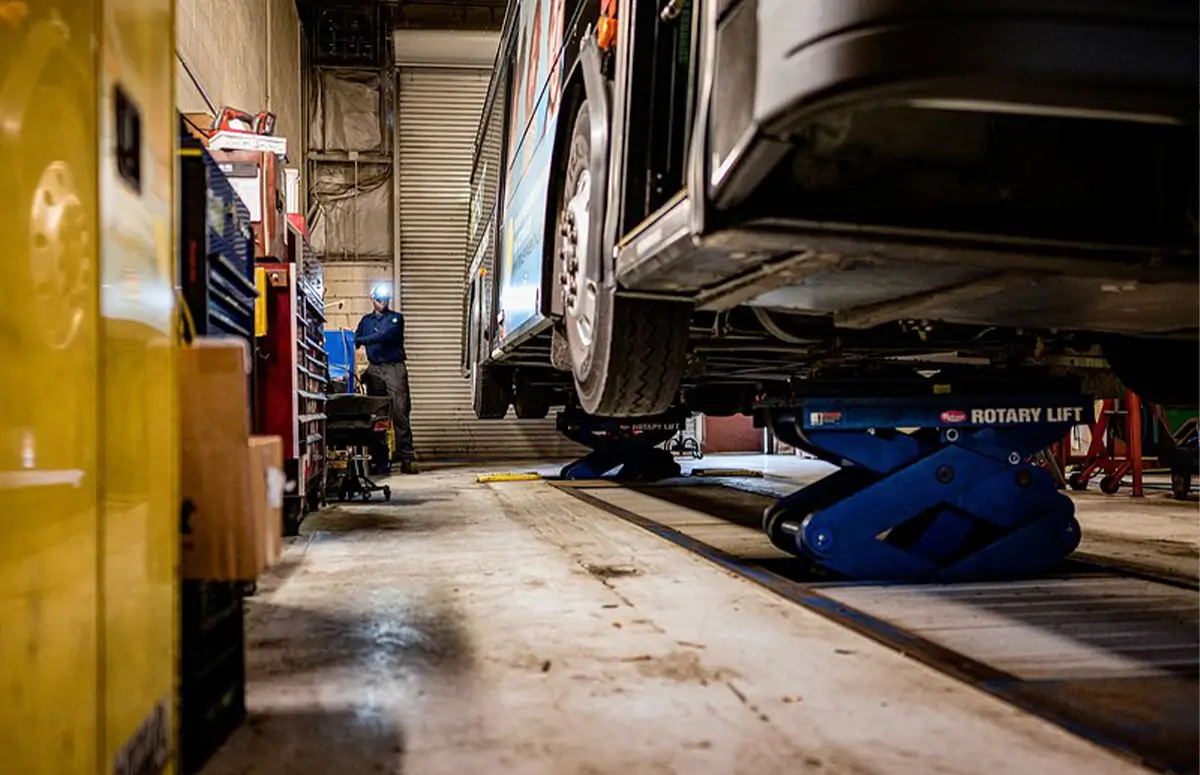
The first thing most people ask when they pull into our bay is what it’s going to cost them. I get it. The trouble is that most of the price guides you find online were written by someone who has never had a 40-foot diesel pusher sitting on a lift. They publish national averages, and those numbers stop meaning anything the moment a tech pulls the wheels and sees what’s actually worn underneath.
So here’s what RV work runs at our shop, based on what comes through our door here in Orlando. We work the mechanical side of motorhomes, which is the same diesel hardware we service on commercial trucks all week. Engine, transmission, brakes, suspension, alignment, emissions. We don’t do interior cabinetry, refrigerators, or slide-out furniture. If your trouble is the chassis under the house, that’s our lane. The full scope is on our RV repair page if you want it.
Why an RV bill lands higher than your car
A motorhome is a heavy diesel chassis hauling a house around. That’s basically the whole reason the invoices land where they do. The parts are built for weight a passenger car never carries, and getting to them eats labor hours because everything hides behind tanks, storage bays, and body panels that nobody designed with a mechanic in mind.
A Class A riding on a Freightliner or Spartan chassis has a lot in common with the trucks we already work on, so we’ve got the lifts, the OEM software, and the bay height to take it in. A regular auto shop usually doesn’t, and that’s why so many RV owners get waved off or hit with a scary “just to look at it” quote. Honestly, most of our motorhome customers found us after striking out at two or three other garages first.
Diagnostics come first
Every job starts with a diagnostic, and ours runs $150, same as it does on the trucks. That buys a tech reading the fault codes on real OEM software instead of a thirty-dollar code reader from the parts store, plus hands and eyes on whatever brought you in. If you do the repair with us, that diagnostic earns its keep, because now we’re quoting off what’s wrong instead of guessing.
Here’s the part worth saying out loud: a check engine light on a diesel coach might be a $40 sensor or it might be a $4,000 emissions job. Nobody can tell you which one over the phone, and anyone who tries is making it up.
Engine work
Most of the engine jobs we see on RVs aren’t full rebuilds. It’s the usual diesel wear we’d see on any truck: injectors, turbos, EGR coolers, head gaskets, water pumps. The chassis under a Class A is generally a Cummins, a Detroit, or a PACCAR, and those are engines we’re already into every day on the engine repair side.
A sensor or minor electrical fix tends to land in the few-hundred-dollar range once we’ve found it. Injectors, turbos, and EGR work usually run into four figures, and we quote those after we’ve had a look. A full engine on a Class A is the big one, and on some coaches that number climbs high enough that it’s worth an honest talk about what the rig is actually worth before you commit to it.
We put engine quotes in writing, every time, after we’ve got eyes on the thing. The number rides on the engine, the parts, and whatever turns up once it’s apart.
Transmission
RV transmissions aren’t built like car transmissions. They’re heavy units made for the weight, often an Allison or something similar, and they want lifts and tooling most shops just don’t keep around. A fluid and filter service is routine and cheap. A slipping or hard-shifting unit is a whole different conversation, and a full rebuild is one of the bigger bills anyone in RV ownership ever runs into.
This is the repair where we end up being the most blunt with people. On a high-mileage coach, a rebuild number sometimes gets close to what the rig would sell for, and when it does, we say so. Keeping a customer matters more to us than one fat invoice. The mechanical side of that lives on our transmission repair page.
Brakes
Brakes are the last place to go cheap on something that weighs as much as a small house. A motorhome brake job costs more than a car’s because the parts are bigger and there’s more of them, but the logic is plain enough: you’re stopping a lot of weight, usually somewhere on a Florida interstate grade. We do brake service on coaches the way we do it on trucks, inspecting the whole system instead of chasing the one pad that squeaked.
Alignment and suspension
If your motorhome wanders, pulls, or eats front tires, it’s usually an alignment problem or worn suspension underneath. RV tires aren’t cheap, so an alignment that saves a set pays for itself in a hurry. Our heavy-duty front-end alignment starts at $189 on the rack, and we measure the things the budget setups skip. Suspension work gets quoted once we find what’s actually worn, whether that’s air bags, shocks, or bushings.
DPF and emissions
Diesel coaches carry the same emissions hardware as the trucks, so they bring the same headaches. A clogged DPF throws codes, derates the engine, and leaves you crawling. A proper DPF cleaning, the kind with a real thermal bake and ash removal, runs $400 to $650 depending on the unit. That’s an actual clean, not a quick blow-out that lasts you a month.
The cost most people forget
If the RV won’t run, you’re into a tow before you’re into anything else, and heavy-duty towing isn’t cheap. We run 24/7 roadside across Central Florida, so if you go down on I-4 or the Beachline, we can often roll out to you instead of leaving you to sort out a flatbed. Good to know before you’re sitting on the shoulder doing that math.
And one thing for the big Class A owners: depending on your coach’s weight and how you use it, your driving may fall under federal rules. The FMCSA guidance on CDL requirements for RV drivers spells out where the weight thresholds sit if you’re wondering whether yours applies.
So what should you set aside?
If you own a motorhome, budget more than feels reasonable for the mechanical side, and find a shop that knows heavy diesel before something breaks instead of after. The owners who get burned on price are almost always the ones calling around in a panic with the rig already sitting dead in a lot. The ones who come out fine already knew where they were taking it.
We quote everything in writing before a single wrench turns. The only honest way to get a real number for your coach is to have a tech put eyes on it. Take a look at the rest of our writing on the blog, or just call.
Need an RV repair quote in Orlando?
Call (407) 591-6747 or stop by 9640 Sidney Hayes Rd. We’ll tell you what it costs before we start.
Top Rides is a diesel truck and RV repair shop in Orlando, FL, at 9640 Sidney Hayes Rd. ASE-certified mechanics. We handle the mechanical side of motorhomes: engine, transmission, brakes, suspension, alignment, and DPF. Phone: (407) 591-6747.