
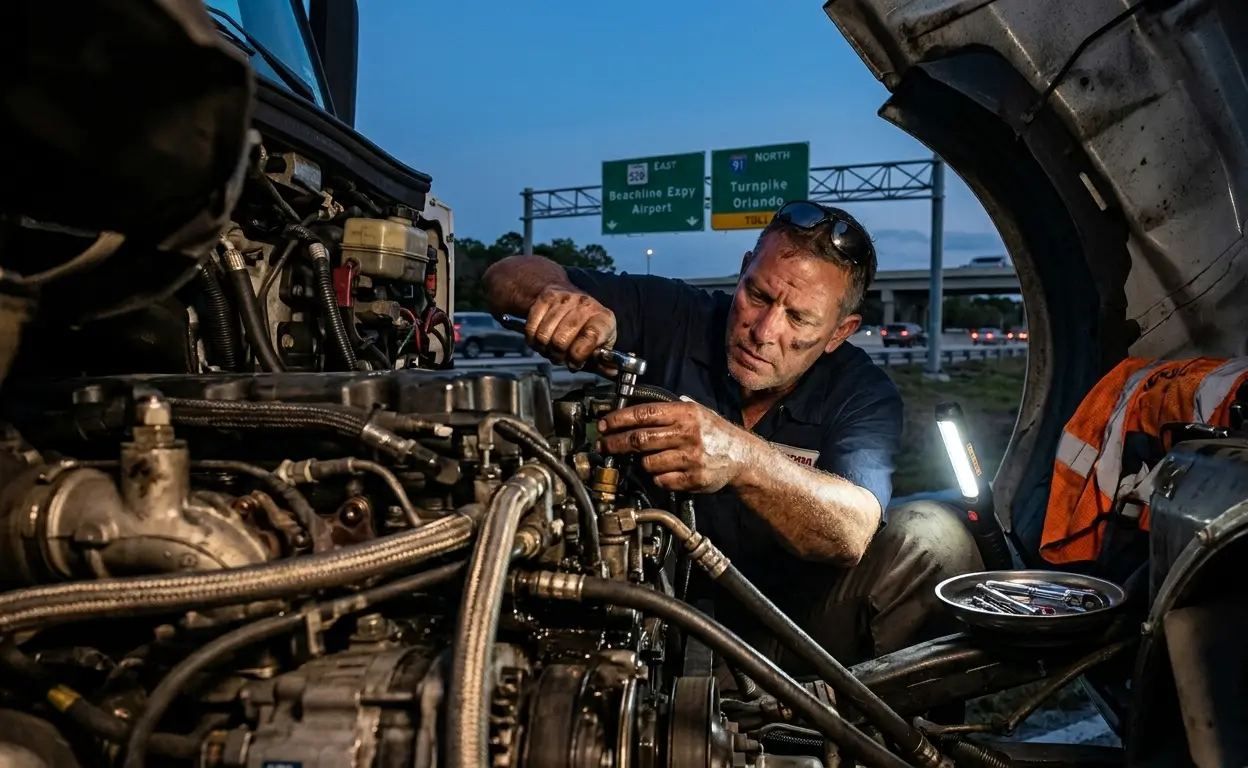
Short answer: A mobile mechanic can fix a lot more on the shoulder than most drivers expect. On the Beachline (528) and the Turnpike, we regularly get trucks running again roadside for no-starts, dead batteries and alternators, air system leaks that won’t let you build pressure, fuel priming after running dry, DEF and SCR derates, coolant hose failures, and sensor faults that trip a limp mode. What we can’t safely do on the shoulder is anything that needs the engine apart: head gaskets, injector cup jobs, turbo replacement, or an in-frame. Those get a tow to the shop. If you’re stopped on the 528 or the Turnpike right now, get your triangles out and call (407) 591-6747.
What a mobile mechanic can actually fix on the shoulder
Here is the honest version, because “24/7 roadside” gets thrown around by a lot of shops that really just mean towing. When our service truck rolls out to the Beachline or the Turnpike, it carries diagnostic gear, common parts, a compressor, and a welder. That covers most of what strands a truck. The repairs we complete roadside, without a tow, are the ones that don’t require opening up the engine.
The calls we clear on the shoulder most often:
- No-starts. Dead batteries, a failed starter, or a bad connection. We test, jump, or swap the part and get you turning over again.
- Alternator failures. If your dash lit up and the truck slowly died, this is usually why. We carry common alternators and can change one on the shoulder.
- Air system leaks. A blown line or a dryer issue that won’t let you build air. We find the leak, patch or replace the line, and get your pressure back.
- Fuel priming after running dry. Ran the tank empty and now it won’t catch? We prime the system and bleed the air out.
- DEF and SCR derates. A NOx or DEF quality sensor throwing an inducement can drop you to a crawl. Often this is a sensor and a software reset, not a teardown, and we can handle it roadside.
- Coolant hose and belt failures. A burst hose or a thrown belt on the shoulder. We carry common sizes and can get you cool enough to reach the shop under your own power.
- Sensor and wiring faults. A single failed sensor can trip a limp mode that feels like a dead engine. We read the code and confirm before replacing anything.
If it can be diagnosed with a scan tool and fixed with a part we carry, there is a good chance we finish it where you sit.
What we won’t fix on the side of the road
This part matters as much as the last one, because a mechanic who promises to rebuild your top end on the Turnpike shoulder is either lying or about to do bad work. Some jobs need a clean, lit, level bay and the truck fully secured. Doing them roadside is unsafe for the tech and bad for the repair.
We tow instead of attempting these on the shoulder:
- Head gasket jobs. The engine has to come apart and stay clean. Not a roadside job.
- Injector cup and injector replacement. Fuel, torque specs, and cleanliness that a shoulder can’t give you.
- Turbocharger replacement. Sometimes doable roadside on a good day, but usually a tow, since a failed turbo often means checking for downstream damage first.
- In-frame overhauls and any major internal work. Shop only, every time.
When we roll up and it turns out to be one of these, we tell you straight, and we get you towed in rather than burning your afternoon on a fix that won’t hold. We run our own heavy-duty towing, so the same call handles both.
The Beachline (528) and Turnpike specifically
These two roads generate a particular kind of breakdown, and it is worth saying why. The 528 runs fast and open from the airport out to the coast, which means trucks are loaded and cruising when a cooling or air problem shows itself, and the shoulders are narrow in stretches with fast traffic right beside you. The Turnpike adds distance between exits, so when you lose air or throw a derate between plazas, you can be a long way from anywhere useful. Both are exactly the routes our Orlando shop sits closest to. We are on Sidney Hayes Rd, off the 528 and about ten minutes from the I-4 and Turnpike split, so a service truck reaches most of that corridor quickly.
Heat plays into it too. Florida summer keeps everything running hot, so marginal hoses, belts, and cooling parts tend to give out on a loaded uphill pull rather than in a cool morning yard. A lot of our 528 and Turnpike calls are cooling-related for that reason.
Before we get there: stay safe on the shoulder
While you wait, the shoulder is the dangerous part, not the breakdown. Get out of the truck on the side away from traffic and put your warning triangles out. Federal rules under FMCSA 392.22 require you to set three of them within ten minutes of stopping: one about ten feet behind the truck on the traffic side, and two more back at roughly 100 and 200 feet in the direction of oncoming traffic. On a curve or a hill, place them further back so drivers see them in time. You can read the exact placement rules on the FMCSA warning devices page. Turn your hazards on and leave them on. If there is fuel leaking, skip anything with a flame and get well clear.
Then call us with two things: your location, including the road and the nearest mile marker or exit, and the fault code if the dash is showing one. Those two details let us bring the right part on the first trip instead of making a second one.
How we diagnose roadside
We don’t guess on the shoulder any more than we do in the shop. The service truck carries the same OEM-level scan tools we use in the bay, so we pull the active fault, read freeze-frame data, and confirm the actual failure before touching anything. A derate that looks like a dead engine is often a single sensor. Replacing the right part once beats swapping guesses on the roadside while traffic goes by. If the code points to something internal, we know that fast, and we switch to getting you towed instead of chasing it in a bad spot. For the deeper electronic side of this, see our semi truck computer diagnostics.
Every roadside call gets quoted before we roll, and you get the paperwork afterward, same as a shop visit. That keeps your FMCSA maintenance records straight without you chasing us for anything. For the full picture of what our road service covers, see our roadside assistance page, and if the problem turns out to be a bigger engine issue, our semi truck engine repair page walks through what that looks like in the shop.
Frequently asked questions
Can a mobile mechanic fix my truck on the Beachline or Turnpike?
Yes, for most roadside failures. We regularly complete no-starts, alternator and battery swaps, air leaks, fuel priming, DEF and SCR derate fixes, and hose or belt failures right on the shoulder. Jobs that need the engine apart, like head gaskets or injectors, get towed to the shop instead.
What engine problems can’t be fixed roadside?
Anything that requires opening the engine or a clean, level bay: head gasket jobs, injector cup and injector replacement, most turbo replacements, and in-frame overhauls. We tow those in rather than attempt them on the shoulder.
How fast can you reach me on the 528 or the Turnpike?
Our shop sits just off the 528, about ten minutes from the I-4 and Turnpike split, so we reach most of that corridor quickly. Time depends on traffic and where you are between exits. Give dispatch your mile marker so we can find you fast.
What should I do while I wait for the mechanic?
Turn on your hazards, get out on the side away from traffic, and place your warning triangles per FMCSA 392.22: one about ten feet behind the truck and two more at roughly 100 and 200 feet toward oncoming traffic. Place them further back on curves and hills. If fuel is leaking, keep anything with a flame away.
Do you handle the tow if the truck can’t be fixed roadside?
Yes. We run our own heavy-duty towing, so one call covers both the roadside diagnosis and the tow to our shop or wherever you need the truck dropped.
Will a DEF derate strand me on the highway?
It can drop you to a crawl, but it is often a sensor issue rather than a mechanical failure. We can usually diagnose and clear it roadside with the right sensor and a software reset, which beats a tow for that particular problem.
Written by the technicians at Top Rides Truck Repair, Orlando, FL. Our shop is at 9640 Sidney Hayes Rd, Orlando, FL 32824, off the Beachline (528). ASE-certified diesel mechanics, bilingual (English and Russian), with mobile and roadside service across the Orlando metro. Call (407) 591-6747.