
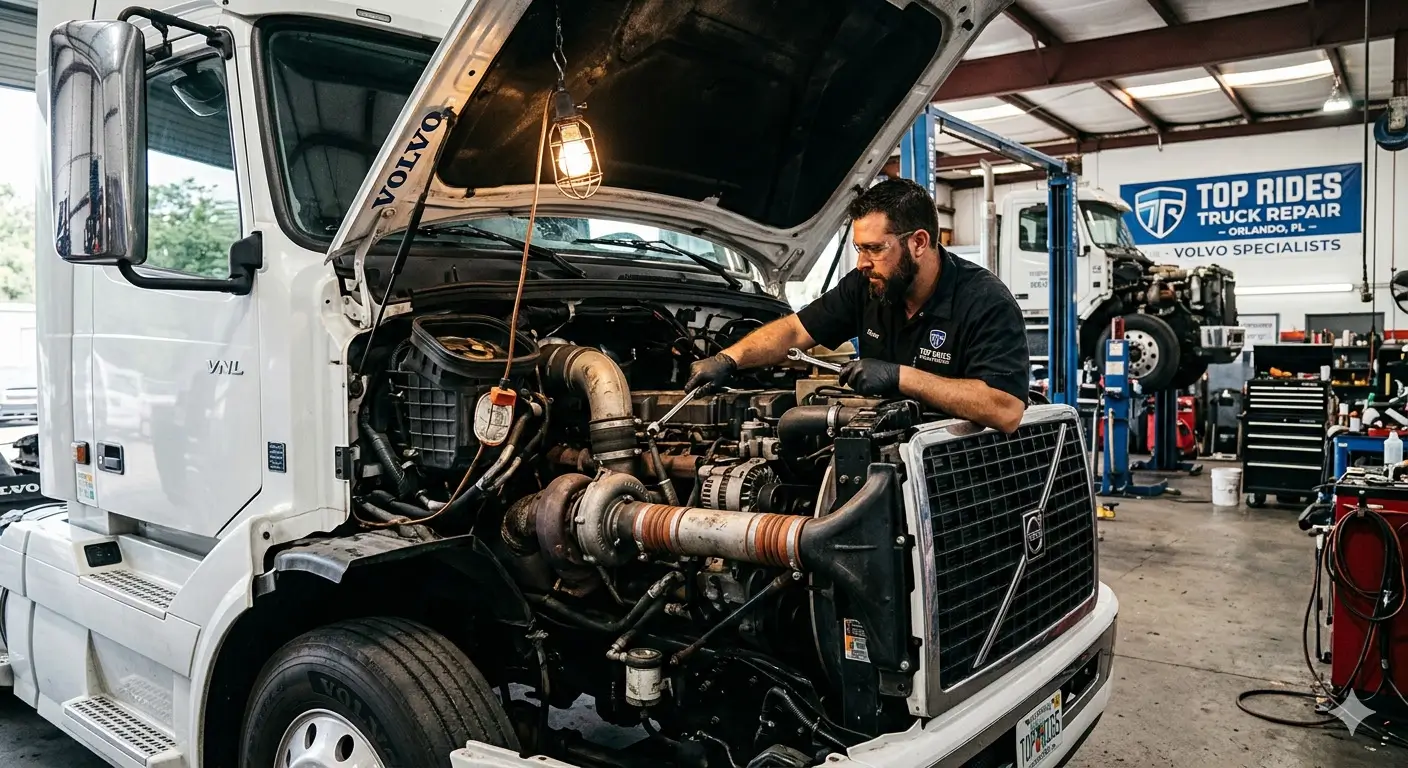
Volvo runs a big share of the freight moving through Central Florida, so a big share of what rolls into our shop wears the iron mark. After years of working on VNLs and VNRs here in Orlando, we see the same handful of failures come up again and again. That is not a knock on the brand. Every make has its weak spots, and once you know a truck’s patterns you can catch trouble before it strands a driver on I-4.
Here are the five Volvo repairs we do most, what causes each one, and how we actually fix them at Top Rides instead of just throwing parts at the problem.
1. EGR cooler failure on the D13
If you own a Volvo with a D13, this is the one to know. The EGR cooler drops the temperature of exhaust gas before it gets recirculated, and on higher-mileage trucks it cracks or clogs. When it cracks, coolant leaks internally, so you lose coolant with nothing on the ground to show for it. When it clogs, EGR flow drops, soot climbs, and the truck starts throwing regen and low-flow codes until it derates you to 5 mph on the side of the road.
The tell is coolant loss with no visible leak, sometimes white smoke, sometimes a truck that will not finish a regen. We pressure-test the cooling system to confirm the cooler is the source before we pull anything, because a leaking radiator or a bad water pump can look similar at first. Once we confirm it, we replace the cooler with an OEM-spec unit, inspect the EGR valve and the flap pipe gasket while we are in there since a bad valve takes the new cooler down with it, and then we clear the codes and run it to make sure flow is back in range. Skipping the valve inspection is how shops end up doing this job twice.
2. DPF and aftertreatment problems
The exhaust aftertreatment on modern Volvos is where a lot of downtime lives. A DPF that never gets a proper cleaning slowly loads up with ash that no regen can burn off. Add a marginal EGR cooler or a lazy DEF dosing system and you get a truck that spends more time in parked regen than it does hauling.
Drivers usually bring these in for repeated regen warnings, poor fuel economy, or a derate. We start with a diagnostic to separate a true DPF ash-load problem from a sensor or dosing fault, because those get fixed very differently. When the filter is genuinely loaded, we do a real DPF cleaning with a thermal bake and pneumatic ash removal, not a quick blow-out that leaves half the ash behind. If a NOx sensor or the DEF pump is the real culprit, we fix that instead so you are not back in two weeks. Getting the diagnosis right is the whole game here.
3. I-Shift transmission faults
The I-Shift is a good automated manual, but it is electronically complex, and complex means diagnosable faults rather than guesswork. The failures we see most are shift complaints: a truck that will not drop into gear, hangs in a gear, or throws a transmission warning and drops to a limp mode. A lot of these trace back to the clutch actuator, a shift solenoid, or worn clutch components rather than the gearbox itself.
We do not open an I-Shift on a hunch. We pull the transmission fault codes with Volvo’s OEM software, watch the actuator data live, and confirm what is actually failing before anything comes apart. Sometimes it is a clutch job. Sometimes it is a sensor or an actuator that costs a fraction of a rebuild. Reading the data first is what keeps a shift complaint from turning into a needless teardown.
4. Front-end and steering wear
Florida heat and rough freight lanes are hard on suspension and steering. On Volvos we see worn king pins, tie rod ends, and cab bushings show up as wandering steering, uneven tire wear, or a front end that feels loose over bumps. Left alone, a worn front end eats a set of steer tires fast and turns into a safety problem.
When a truck comes in pulling or wandering, we inspect the whole front end for play, check the king pins and tie rods, and look at the suspension bushings and air bags. We replace what is worn and then put it on the alignment rack, because there is no point fixing steering components without setting caster, camber, and toe back to spec afterward. New parts on a bad alignment still chew tires.
5. Electrical and sensor gremlins
Modern Volvos are rolling networks, and a lot of what looks like a mechanical failure is actually a sensor, a connector, or a wiring fault. Chafed harnesses, corroded grounds, and failing sensors throw codes that send drivers chasing the wrong parts. We see trucks that had a good component swapped out twice because nobody chased the wiring.
This is where diagnostic depth pays off. We use OEM Volvo diagnostic software to read the fault chain, then trace it back to the real source instead of replacing the first part the code points at. A five-dollar connector repair beats a new module every time, and finding it takes the right tools and the patience to follow the harness. That is the difference between a fix and a parts-swap that comes back.
Why the diagnosis matters more than the part
If there is a theme across all five of these, it is that Volvos reward a shop that reads the truck before it turns a wrench. Every one of these repairs can be done wrong by guessing, and every one gets done right by pulling the data first. We run OEM software for Volvo specifically, which is why we can catch the EGR-cooler-into-DEF chain reaction or the wiring fault behind a sensor code that a general shop would miss.
If you want to keep these off your repair schedule in the first place, our guide to preventive maintenance for heavy-duty trucks covers the intervals that catch most of this early, and our page on computer diagnostics explains how we read Volvo fault codes. Depending on what your truck needs, the fix usually starts with diesel engine repair, transmission repair for I-Shift work, DPF cleaning for aftertreatment, or suspension repair for front-end wear.
Bring your Volvo to Top Rides in Orlando
We work on Volvos every day at our shop at 9640 Sidney Hayes Rd in Orlando. Our mechanics are ASE-certified, we have the OEM Volvo software to diagnose these trucks properly, and we quote in writing before any work starts. If your truck is already down or acting up on the road, we run 24/7 roadside assistance across Central Florida, including I-4, the Turnpike, and the Beachline.
Call (407) 591-6747 or reach out through our contact page to get your Volvo looked at. You can also read more about our shop and our techs on our about us page.
Keeping a commercial truck in safe operating condition is not just about avoiding breakdowns. The FMCSA lays out the inspection, repair, and maintenance rules for commercial vehicles under 49 CFR Part 396, and staying on top of these five repairs keeps you compliant as well as running.
Frequently asked questions
What is the most common Volvo D13 engine problem?
EGR cooler failure is the one we see most on higher-mileage D13 engines. It shows up as coolant loss with no visible leak, sometimes white smoke, and often a truck that cannot finish a regeneration and eventually derates. We pressure-test to confirm the cooler is the source, then replace it and inspect the EGR valve so the job does not have to be done twice.
Why does my Volvo keep going into regen?
Constant regens usually mean the aftertreatment system is struggling, most often a DPF loaded with ash, a clogged or leaking EGR cooler, or a DEF dosing fault. The fix depends on which one it is, so we diagnose first rather than assuming the filter. A true ash-load problem gets a thermal DPF cleaning, while a sensor or DEF pump fault gets repaired directly.
Can you fix Volvo I-Shift transmission problems?
Yes. Most I-Shift complaints, like a truck that will not drop into gear or drops to a limp mode, trace back to the clutch actuator, a shift solenoid, or worn clutch parts rather than the gearbox. We pull the transmission fault codes with Volvo OEM software and watch the actuator data live before anything comes apart, which often turns a suspected rebuild into a much smaller repair.
How much does Volvo semi truck repair cost in Orlando?
It depends on the repair. Diagnostic starts at $150, DPF cleaning runs $400 to $650 depending on the unit, and engine or transmission work gets quoted after we look at it. We quote in writing before any wrench turns, so you get a real number instead of a surprise. Call (407) 591-6747 for a quote.
Do you work on all Volvo truck models?
Yes. We work on Volvo VNL, VNR, and older VN models with D11, D13, and D16 engines, plus I-Shift and manual transmissions. We have the OEM Volvo diagnostic software, so we can read fault codes and program components that a general auto shop cannot. We are at 9640 Sidney Hayes Rd, Orlando, FL 32824.
Written by the diesel team at Top Rides, a semi truck repair shop in Orlando, FL. Our mechanics are ASE-certified and work on all makes and models, including the full Volvo lineup. Reviewed for accuracy by our lead technician.