
Published by Top Rides Truck Repair, 9640 Sidney Hayes Rd, Orlando, FL 32824. Call (407) 591-6747.
Reviewed by ASE-certified technicians, Top Rides Truck Repair, Orlando FL.
Almost every Class C that rolls into our bay is sitting on a Ford E-350 or E-450 cutaway, and it has one of two engines in it. Either the 6.8 liter Triton V10, or the 7.3 liter V8 that everyone calls Godzilla.
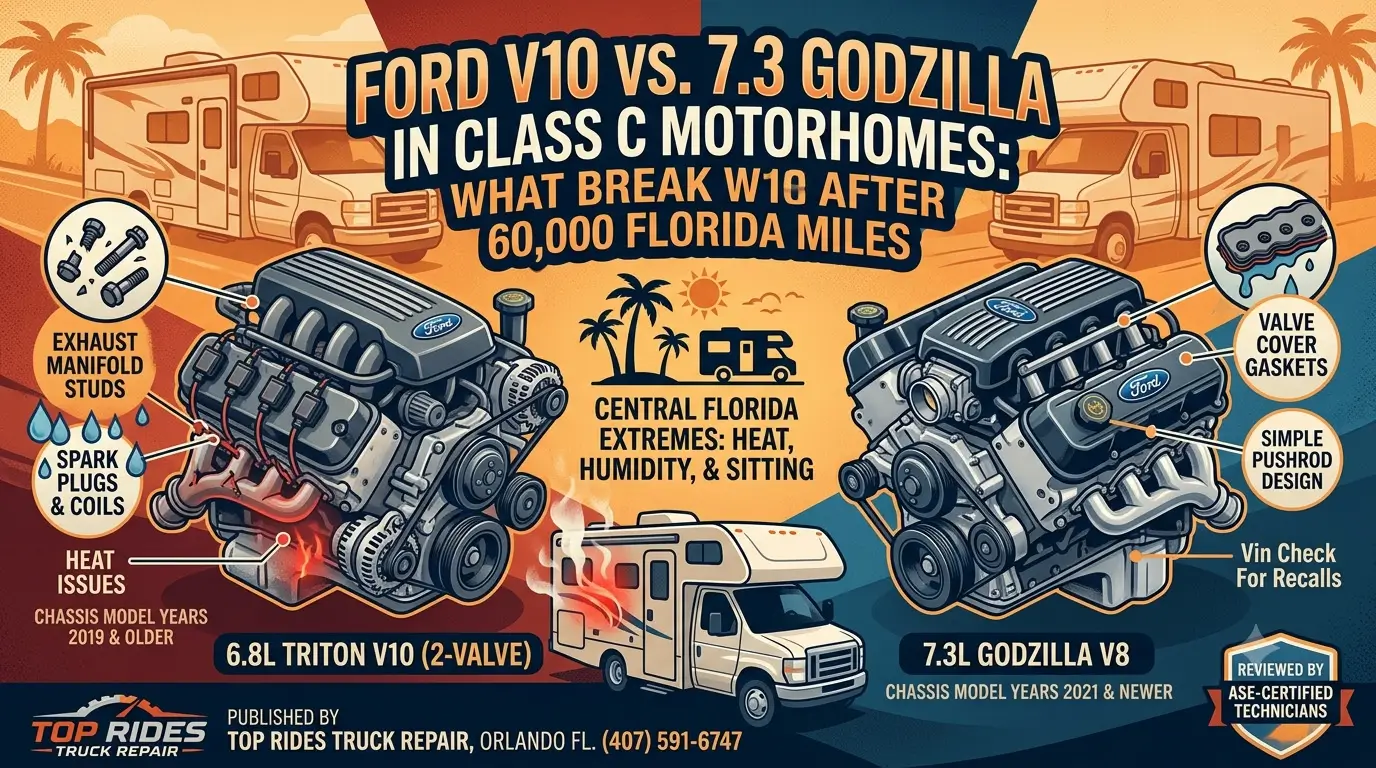
The dividing line is 2021. Ford skipped the E-Series entirely for the 2020 model year, and when it came back for 2021 the V10 was gone and the Godzilla was standard across the lineup. So if your coach is a 2021 or newer, you have the V8. If it is 2019 or older, you have the V10. If it says 2020 or 2021 on the title, go look at the engine, because RV builders buy chassis a year or more ahead and the badge on the coach does not always match what is under the doghouse.
I want to spend most of this on the V10, because that is what most Class C owners in Central Florida are actually driving, and because a lot of what gets written about it does not apply to your coach at all.
The V10 article you read was probably about a different engine
Search “Ford V10 problems” and you will get two spark plug stories mashed together.
Story one: the early 2-valve engines had cylinder heads with only about four threads holding the spark plug in. Under heat cycling, plugs would work loose and eject out of the head. Owners describe a loud pop and a sudden miss. Ford revised the head design in the early 2000s, usually cited as 2003 to 2004, going to a deeper thread.
Story two: the 3-valve engines used a two-piece spark plug that carbons up and seizes, then snaps in half when you try to remove it, leaving the ground shell down in the hole. Ford went to a one-piece plug around 2009.
Here is the part that matters and almost nobody mentions. The 3-valve V10 never went in the E-Series. It needed a wider engine bay, so Ford put it in the Super Duty trucks and in the F-53 Class A motorhome chassis. The E-350 and E-450 cutaway that your Class C is built on kept the 2-valve version its whole run.
So if you own a Class C, story two is not your problem. Story one might be, depending on your chassis year.
And do not trust the model year on the coach to answer that. We have had a 2004 Class C come through with a 2003 chassis under it. Go find the certification label on the driver’s door jamb and read the actual chassis build date. That is the number that tells you which heads you have.
If you are in the older group, you have options. Nobody can predict a blowout, and I am not going to tell you to preemptively pull all ten holes apart on a coach that has never had a problem. What I will tell you is that most blowouts we see happen shortly after a plug change, because somebody cross threaded one or torqued it wrong in a hole with almost no thread to work with. If you are changing plugs on an early 2-valve, that is not the job to hand to a general shop that does this once a year.
What actually breaks on a V10 Class C at 60,000 miles here
Sixty thousand is an interesting number for these, because the V10 itself is not tired at 60,000. Well maintained ones run 250,000 to 300,000 miles routinely, and I have seen higher. The engine is not the problem. The stuff hanging off it is.
Spark plugs and coils. Ford’s interval is long, and long intervals plus Florida humidity is a bad mix. Plugs corrode into aluminum heads. Coil boots cook against a hot engine sitting inside the cab. We recommend plugs and coil boots somewhere in the 60,000 to 80,000 range rather than waiting for the manual’s number, because a plug that has been in a humid aluminum head for a decade is a different removal job than one that has been in for five years. Misfire codes in the P0301 through P0310 range are usually where this shows up first, and the coach will feel it as a stumble under load on an on ramp before it ever throws a light.
Exhaust manifold studs. This is the most common V10 job in our shop. The cast manifolds expand and contract against the head every heat cycle and eventually the studs snap. You hear it as a tick on cold start that quiets down once everything expands and seals. Most owners decide it is a lifter and worry about it for a year. It is almost never a lifter. Get it looked at early, because a broken stud you catch is a manageable job and a broken stud you ignore turns into a warped manifold and extraction work down in the head.
The cooling stack. This is where Florida does its own damage. Love bug season hits twice a year, roughly May and September, and a coach that runs I-4 or the Turnpike during it comes back with the AC condenser and radiator packed solid. The coach still cools fine at 70 mph. Then you sit in traffic near the attractions on a 95 degree afternoon with the dash air on and the temp needle starts climbing. Owners blame the thermostat. Half the time we pull the coach in, look at the stack, and the airflow is simply gone. If the dash air is also weak, that is the same root cause, and our RV and truck AC repair page covers the rest of that system.
Heat in the cab. Not a failure, but worth saying because it drives a lot of calls. The V10 sits inside the cab under a doghouse. It puts heat and noise where you sit, and it also means engine access is genuinely miserable. That is why a job that is two hours on a pickup is four on your Class C. When you get a quote that seems high for a simple repair, this is usually why, and any honest shop will explain it that way instead of just handing you a number.
Fuel economy. Seven to nine mpg loaded is normal. If yours drops noticeably, look at plugs, a dragging brake, or low tire pressure before you assume the engine is dying.
Our transmission repair side sees the TorqShift automatic behind these mostly when someone has been climbing grades out of tow/haul mode or has never changed the fluid. Neither is an engine problem, but they end up on the same repair order.
What we see on the Godzilla so far
Honest answer: less, and I want to be careful about how confidently I say that.
The 7.3 has only been in the E-Series since 2021. A coach with 60,000 miles on a Godzilla is a high mileage example of a young engine, and we simply do not have the twenty years of failure data we have on the V10. Anyone telling you they know exactly how these age at 200,000 miles is guessing.
What I can say is that the design is deliberately simple. Cast iron block, pushrods with the cam in the block, port fuel injection, no turbo. That means no timing chain phaser problems, no direct injection carbon buildup on intake valves, and no turbo to fail. For a vehicle that is going to sit for months and then be asked to haul 14,000 pounds through Florida heat, simple is exactly what you want.
Now the correction that saves Class C owners a lot of unnecessary worry. Search “7.3 Godzilla problems” and most of what you find is about the 10-speed 10R140 transmission, including a well documented drum bushing failure that can take out drive entirely. That transmission is behind the Godzilla in Super Duty trucks.
It is not in your Class C. The E-350 and E-450 with the 7.3 use Ford’s TorqShift six-speed. Different transmission, different failure modes, and the 10R140 horror stories do not transfer to your coach. I have had customers walk in genuinely worried about a part their motorhome does not have.
Power ratings on the E-Series 7.3 have moved around by model year and calibration, roughly 325 to 350 horsepower and 450 to 468 lb-ft depending on which year and which tune your chassis got. Ford offered a Premium and an Economy calibration early on and dropped the Economy option for 2024. Practically, you will feel more usable pull than the V10 had, and the cab is quieter.
What we actually touch on these so far is unglamorous: valve cover and oil pan gasket seepage, throttle bodies dirty enough to cause a rough idle, and plugs and coils on the higher mileage ones. Ordinary stuff.
One thing to do rather than worry about: check your chassis VIN for open recalls. There has been at least one campaign affecting 2021 E-Series cutaways with this engine. Do not rely on your coach builder’s recall page for this, because a motorhome carries the chassis manufacturer’s VIN and Ford files drivetrain recalls separately from whatever Thor or Winnebago or Coachmen files. Run the VIN off your driver’s door jamb through NHTSA’s recall lookup. It takes a minute and it is free, and I would do it today rather than the week before a trip.
So which one would I rather own
The Godzilla, if I am buying. It has more usable power, it is quieter, the doghouse is smaller, and the architecture has fewer things on it that can go expensively wrong.
But I would not sell a good V10 coach to go get one, and I want to be clear about that because there is a lot of online pressure suggesting the V10 is junk. It is not. It is an engine with two well documented spark plug quirks, one of which does not even apply to your Class C, and a manifold stud problem that is annoying rather than serious. Underneath that it is one of the more durable gas engines Ford has built. A 2015 Class C with 60,000 miles and service records is a better buy than a neglected newer one, and it will cost you less to insure and register.
The deciding factor is usually not the engine anyway. It is whether the previous owner drove it or stored it. We get into that in the top 5 biggest problems RV owners face.
What Florida specifically does to both of these
I have worked on diesel and gas in this state for a long time, and Central Florida is harder on a motorhome than the mileage suggests.
Heat and stop and go traffic are the obvious ones, and they affect anything with an engine. We wrote about why Orlando heat and I-4 traffic wear vehicles faster from the truck side, and coaches are worse because they are heavier, taller, and geared to work harder at the same speed.
Humidity is the quieter one. It corrodes plugs into heads, it gets into connectors, and it rusts exhaust hardware from the outside in.
Then there is sitting, which is the biggest one for RVs and gets almost no attention. Pump gas with ethanol in it does not age well in a tank over a Florida summer. Fuel goes stale, rubber dries out, rodents find a warm engine bay in a storage lot, and everything that was fine in April is not fine in October. A coach that gets driven thirty minutes once a month ages better than one that sits from May to October. That is free advice and it is worth more than most of the paid kind.
Service intervals I would actually follow
For the V10, plugs and coil boots at 60,000 to 80,000 miles rather than the longer factory number, and have the exhaust manifold studs inspected any time you hear a cold start tick. Clean the radiator and condenser stack after love bug season, both times. Coolant on a time basis, not just mileage.
For the Godzilla, follow the factory schedule and add a cooling stack cleaning on the same schedule, because bugs do not care which engine is behind the grille. Check the VIN for recalls now, and again yearly.
For both, get the coach on the calendar once a year regardless of miles. Time and humidity do more to these than driving does. If you need a starting point on cost, we published what RV repairs actually run in Orlando using our own numbers. Diagnostic starts at $150 and comes off the repair.
Common questions about Ford motorhome engines in Orlando
Which engine does my Class C have? 2019 model year chassis and older will have the 6.8 V10. 2021 and newer will have the 7.3 Godzilla. Ford did not build the E-Series for 2020. Confirm using the chassis build date on the driver’s door jamb label rather than the model year on the coach, because RV builders often use a chassis that is a year or more old.
Does the Ford V10 spark plug blowout problem affect my Class C? Possibly, if your chassis is from the earlier years before Ford revised the cylinder head design in the early 2000s. The other V10 spark plug issue, where 3-valve plugs break during removal, does not apply to Class C motorhomes at all, because the 3-valve engine did not fit the E-Series bay.
Is the 7.3 Godzilla more reliable than the V10? On design, it has fewer failure points, and that is a real advantage. On track record, it has only been out since 2020 and we do not have long term high mileage data yet. Both are durable engines. Maintenance history matters more than which one you have.
Does my Class C have the 10-speed transmission with the known problems? No. The E-350 and E-450 with the 7.3 use Ford’s TorqShift six-speed. The 10R140 ten-speed that most Godzilla articles discuss is in Super Duty trucks, not in your cutaway chassis.
How often should a Class C motorhome be serviced if I barely drive it? Once a year on the calendar. Low mileage is not the same as low wear on an RV in Florida, because humidity, heat, and stale fuel do their damage while the coach sits.
Do you work on gas motorhomes or only diesel? Both. We handle the chassis and drivetrain on Class A diesel pushers and on gas Class C coaches, including engine repair and computer diagnostics with the factory software for your chassis. We do not work on the living quarters.
Where are you located and what areas do you serve? 9640 Sidney Hayes Rd, Orlando, FL 32824, a few minutes off the Beachline (528) and close to the Turnpike. We see coaches from Orlando, Kissimmee, Sanford, Apopka, Winter Garden, St. Cloud, Lake Buena Vista, and the rest of Orange and Osceola County.
Bring the coach in before the season
If your Class C has a cold start tick, a stumble under load, or a temperature needle that climbs in traffic, those are the three calls we get most and none of them get better on their own.
Call (407) 591-6747 or get in touch. Everything we handle on coach chassis and drivetrain is on our RV repair in Orlando page. If you are already stuck somewhere, we run 24/7 roadside assistance across Central Florida and can tow the coach in.
Top Rides Truck Repair 9640 Sidney Hayes Rd, Orlando, FL 32824 (407) 591-6747 Monday to Friday, 8AM to 6PM. Roadside available 24/7. ASE-certified technicians. English and Russian spoken.