
Published by Top Rides Truck Repair, 9640 Sidney Hayes Rd, Orlando, FL 32824. Call (407) 591-6747.
Reviewed by ASE-certified diesel technicians, Top Rides Truck Repair, Orlando FL.
Here is the part that catches most coach owners off guard: your air brakes will not warn you.
If you have driven cars your whole life, you learned to trust the pedal. Hydraulic brakes go soft when something is wrong. Fluid gets low, a line weeps, the pedal sinks a little further every month, and eventually you notice. Your foot tells you.
Air brakes do not work like that. The pedal is a valve. Push it, and it meters out air pressure. Push it the same distance next year and it meters out the exact same pressure, whether your brakes are in perfect adjustment or three quarters worn out. The pedal feels identical. The stopping distance does not.
That gap between what you feel and what is actually happening under the coach is the whole reason I wanted to write this one down.
What is actually happening down there
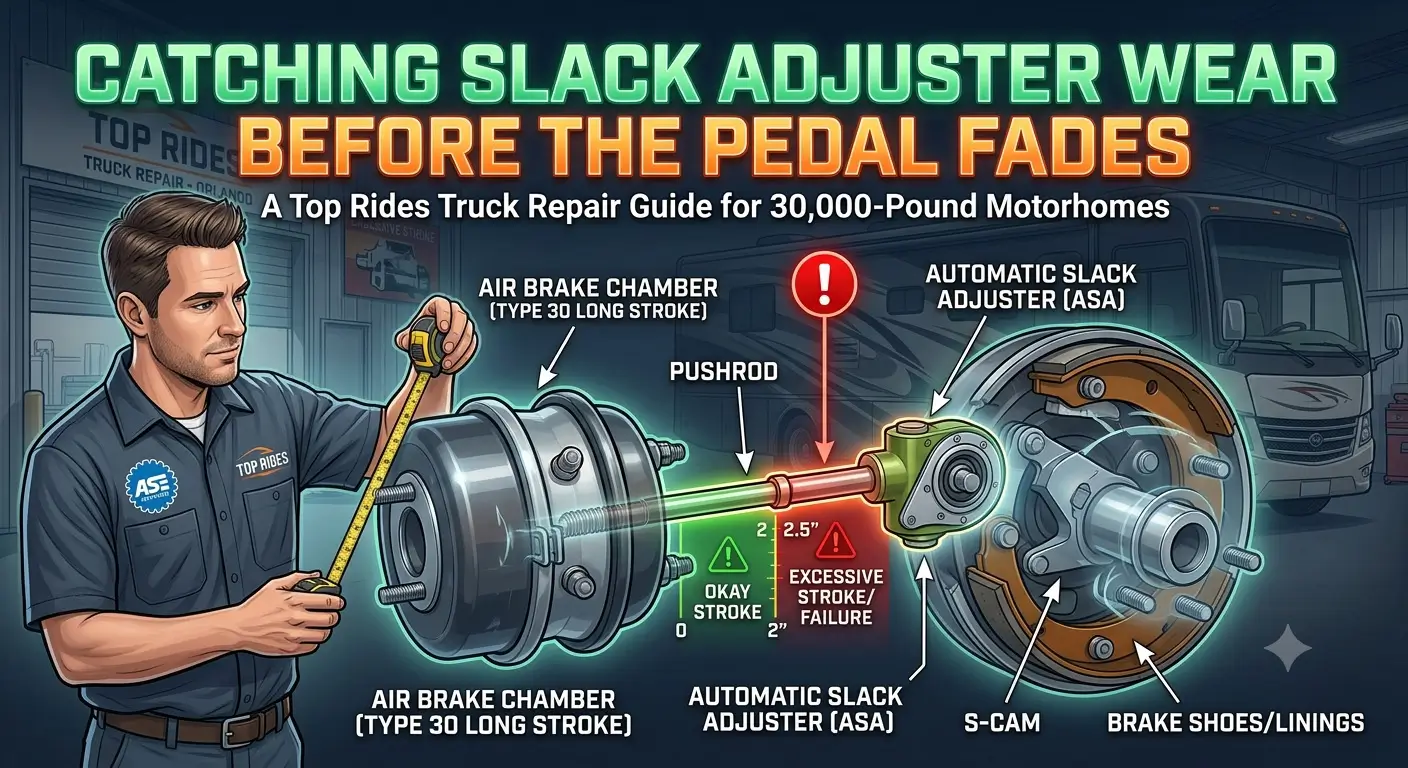
Most Class A diesel pushers built on a Freightliner XC or Spartan K2 chassis run S-cam air drum brakes. Air enters a brake chamber, pushes a diaphragm, and the diaphragm shoves a pushrod out. That pushrod connects to a slack adjuster, which is basically a lever arm on a splined shaft. The lever rotates the S-cam, the cam spreads the shoes, and the shoes press on the drum.
The pushrod only travels so far. Roughly two inches on a common type 30 long stroke chamber, less on smaller ones.
Now think about what wear does. Every time the linings get thinner, the shoes have to travel a little further before they touch the drum. The slack adjuster has to rotate a little further. The pushrod has to come out a little further. That extra travel is called stroke, and it eats into your reserve.
The slack adjuster’s job is to take that slack back out automatically as the linings wear. Nearly every coach on the road has automatic slack adjusters, and they have been standard equipment on air braked vehicles since the mid nineties. When one stops adjusting, nothing announces it. Stroke just quietly grows.
Here is why growing stroke matters more than it sounds. As the pushrod extends further, the angle between it and the slack adjuster arm gets worse, and the mechanical advantage drops off. You are still sending 90 psi to the chamber. You are just getting less clamping force at the drum for it. Then you crest a grade with 30,000 pounds behind you and find out how much less.
Why this bites motorhome owners harder than truckers
I work on both, in the same bay, with the same tools. The difference is not the hardware. It is the duty cycle.
An owner operator running out of Orlando puts 100,000 miles on a truck in a year. He is in our shop constantly, and somebody looks at his brakes every few months whether he asks or not. Federal rules make sure of it.
A coach owner puts 3,000 miles on in a year. Sometimes less. The rest of the time the rig sits.
So RV owners run the mental math that seems obvious: low miles, low wear, brakes are fine. And on the friction material, sure, that is often true. Your linings might be thick.
But slack adjusters do not wear out from mileage. They seize up from sitting.
Central Florida is unusually hard on parked air brake systems, and I say that having worked here for twenty years. Humidity gets pulled into the air system every time the compressor runs. If the air dryer cartridge is old, and on coaches it almost always is because nobody changes them on a time basis, moisture and compressor oil carry through into the lines. That crud finds its way into the slack adjuster’s internal clutch mechanism. Then the coach sits at a storage lot off Boggy Creek Road for six months in the heat, the moisture works on the camshaft bushings and the clevis pins, and everything down there develops a light film of corrosion.
The owner comes back in October, does a walk around, sees no puddles, and heads for Sanford to start the season. The brakes were adjusting fine in April. They are not adjusting now, and there is no symptom in the cab telling him so.
We wrote about the most expensive brake problems we see and how to avoid them from the truck side. The RV version of that list is shorter and it starts here.
The symptoms you can actually catch
Since the pedal will not tell you, you have to look for the secondary stuff. In rough order of how often we see it:
Your coach pulls to one side when you brake hard. One wheel end is doing more work than its partner across the axle, usually because one slack adjuster quit and the other did not.
You are getting uneven lining wear side to side. Pull a wheel, or look through the inspection slot, and compare. If the left front lining is noticeably thinner than the right, something is not sharing the load.
The air compressor cycles more than it used to. Longer stroke means more air volume per application.
You smell hot brake on a long downhill. Fewer wheel ends carrying the same load means the ones still working get very hot.
Stops that used to feel routine now feel long. This is the vaguest sign and the one owners talk themselves out of. Trust it anyway.
A dragging brake, which is the opposite failure. An adjuster that over adjusts or a return spring that gave up will hold a shoe against the drum. That shows up as heat, glazed lining, and worse fuel mileage.
None of these are subtle once you know to look. The problem is that a walk around inspection does not include any of them.
How we actually measure it
There is no guessing involved, which is the good news. Applied pushrod stroke is a number you can measure with a tape.
We chock the wheels, drain the tanks down and build back up, shut the engine off, and get reservoir pressure into the range the federal standard specifies. Appendix A to Part 396 calls for measuring with the engine off and reservoir pressure at 80 to 90 psi with the brakes fully applied. Then we mark the pushrod where it exits the chamber with the brakes released, have someone hold the pedal down hard, and measure how far that mark traveled.
Then we compare it to the readjustment limit for that specific chamber. The limits are published in 49 CFR 393.47, and they are not one number. They depend on chamber type and whether it is a standard or long stroke chamber. A type 24 clamp chamber has a readjustment limit of 1 3/4 inches standard, 2 inches long stroke. A type 30 goes 2 inches standard, 2 1/2 long stroke.
One clarification, because coach owners ask me this constantly and get bad answers online. Those federal rules govern commercial motor vehicles. Your privately owned motorhome is generally not one, and nobody is going to put your coach out of service at a scale house on the Turnpike. You are not legally required to meet those numbers.
We use them anyway. The hardware under your coach came off the same shelf as the hardware under a Kenworth, and the physics do not care what the registration says. If a Type 30 chamber on a semi is unsafe past two inches of stroke, it is unsafe past two inches on your Newmar. Applying a stricter standard than the law requires costs you nothing and it is the honest way to do it.
We also check the things that produce a misleading stroke reading, because this is where cheap inspections go wrong. Worn clevis pins and elongated holes in the yoke add lost motion that reads as excess stroke when the adjuster is actually fine. Worn camshaft bushings do the same. Replace a perfectly good slack adjuster because you skipped that step and you have spent the customer’s money on nothing.
What we do when one is out of spec
Here is the rule I wish more shops followed: if you have to manually adjust an automatic slack adjuster to bring stroke back into range, that slack adjuster has failed. Replace it.
Manually adjusting an ASA is a diagnostic step, not a repair. It will hold for a few hundred miles and then the stroke creeps right back out, because the mechanism that was supposed to be doing that job on its own is still broken. I have inherited coaches where three different shops manually cranked the same adjuster over two years. That is not maintenance. That is a countdown.
So we replace the adjuster, and we replace it in pairs across the axle, because federal spec requires slack adjusters on each end of an axle to have the same effective length and because a new adjuster paired with a tired one just gives you a fresh imbalance. While the wheel end is apart we check lining thickness, drum condition and thickness, the S-cam and its bushings, the anchor pins, and the chamber diaphragm for leaks.
On pricing, I would rather point you at real numbers than hand wave. We break down what we actually charge for coach work in what RV repairs cost in Orlando. Diagnostic on an air brake system starts at $150 and comes off the repair if you have the work done here. Anything past that gets quoted in writing before a wrench turns, which is the part that matters more than the number.
The maintenance interval nobody tells RV owners
Have your air brakes inspected once a year, or before any trip longer than a few hundred miles, regardless of mileage.
Not every 15,000 miles. Not “when they feel funny.” Once a year, on the calendar, because the failure mode we have been talking about is driven by time, moisture, and sitting rather than by use.
Two things to add to that. Change your air dryer cartridge on a schedule, roughly every two to three years for a coach that does not run much, because a saturated dryer is upstream of half the problems in this article. And if your rig sits for the summer, exercise it. Drive it thirty minutes, make some real brake applications, drain the tanks. A coach that moves once a month ages better than one that sits from May to October.
If a brake job is on the list, our brake service page covers what a full air brake job includes. If your coach is also chewing front tires or wandering on the highway, that is a separate problem and our alignment services page explains it. And if the brakes are the reason you are stuck somewhere instead of the reason you came in, we run 24/7 roadside assistance across Central Florida and can tow the coach in if it should not be driven.
Common questions about RV air brakes in Orlando
Does my motorhome legally need a DOT brake inspection?
Generally no. A privately owned RV used for personal travel is not a commercial motor vehicle, so the federal inspection requirements do not apply to you. The engineering limits still describe when the hardware stops being safe, which is why we measure against them anyway.
How often should RV air brakes be checked?
Once a year, and before any long trip. Time and humidity do more damage to a coach’s brake system than mileage does, so a low odometer reading is not a reason to skip it.
My brake pedal feels totally normal. Can my brakes still be out of adjustment?
Yes, and this is the single most important thing in this article. Air brake pedals are valves, not hydraulic pistons. Pedal feel does not change as adjustment goes out. Measuring applied pushrod stroke is the only way to know.
Can I just adjust the slack adjusters myself?
On an automatic slack adjuster, you should not have to, and needing to is the symptom. If manual adjustment brings the stroke back, the adjuster has failed internally and will drift out again within a few hundred miles. Replace it instead.
Do you work on Class C motorhomes too?
Yes, though most Class C rigs on a Ford or Chevy chassis run hydraulic brakes rather than air, so everything in this article applies to Class A diesel pushers and the heavier coaches. Class C brake work is a different job with a different price. We cover both.
Where are you and what areas do you cover?
We are at 9640 Sidney Hayes Rd in Orlando, FL 32824, a few minutes off the Beachline (528) and close to the Turnpike. We see coaches from Orlando, Kissimmee, Sanford, Apopka, Winter Garden, St. Cloud, Lake Buena Vista, and the rest of Orange and Osceola County, plus snowbirds coming down I-75 and the Turnpike for the season.
Get the brakes measured before the season starts
If your coach has been sitting through a Florida summer, or you cannot remember the last time anyone put a tape on the pushrods, that is the job to book before your next trip. It is a short inspection and it either gives you a clean number or it finds the thing that was never going to announce itself.
Call (407) 591-6747 or get in touch. More on what we handle on coach chassis and drivetrain is on our RV repair in Orlando page.
Top Rides Truck Repair 9640 Sidney Hayes Rd, Orlando, FL 32824 (407) 591-6747 Monday to Friday, 8AM to 6PM. Roadside available 24/7. ASE-certified diesel technicians. English and Russian spoken.