
Published by Top Rides Truck Repair · 9640 Sidney Hayes Rd, Orlando, FL 32824 · (407) 591-6747
At some point the diagnosis stops being about a part and starts being about the whole engine. Maybe you spun a bearing. Maybe there’s coolant where it shouldn’t be and the block is cracked. Maybe the thing has 900,000 hard Florida miles on it and the in-frame math just doesn’t work anymore. Whatever got you here, you’re now staring at the three-way choice every owner-operator and fleet manager dreads: reman, rebuilt, or new.
There’s a lot of loose talk about these terms, and some of it is on purpose. “Rebuilt” and “remanufactured” get used like they mean the same thing, and they don’t. The gap between them is real money and real reliability, so let’s clear it up before you sign off on anything.
What each one actually means
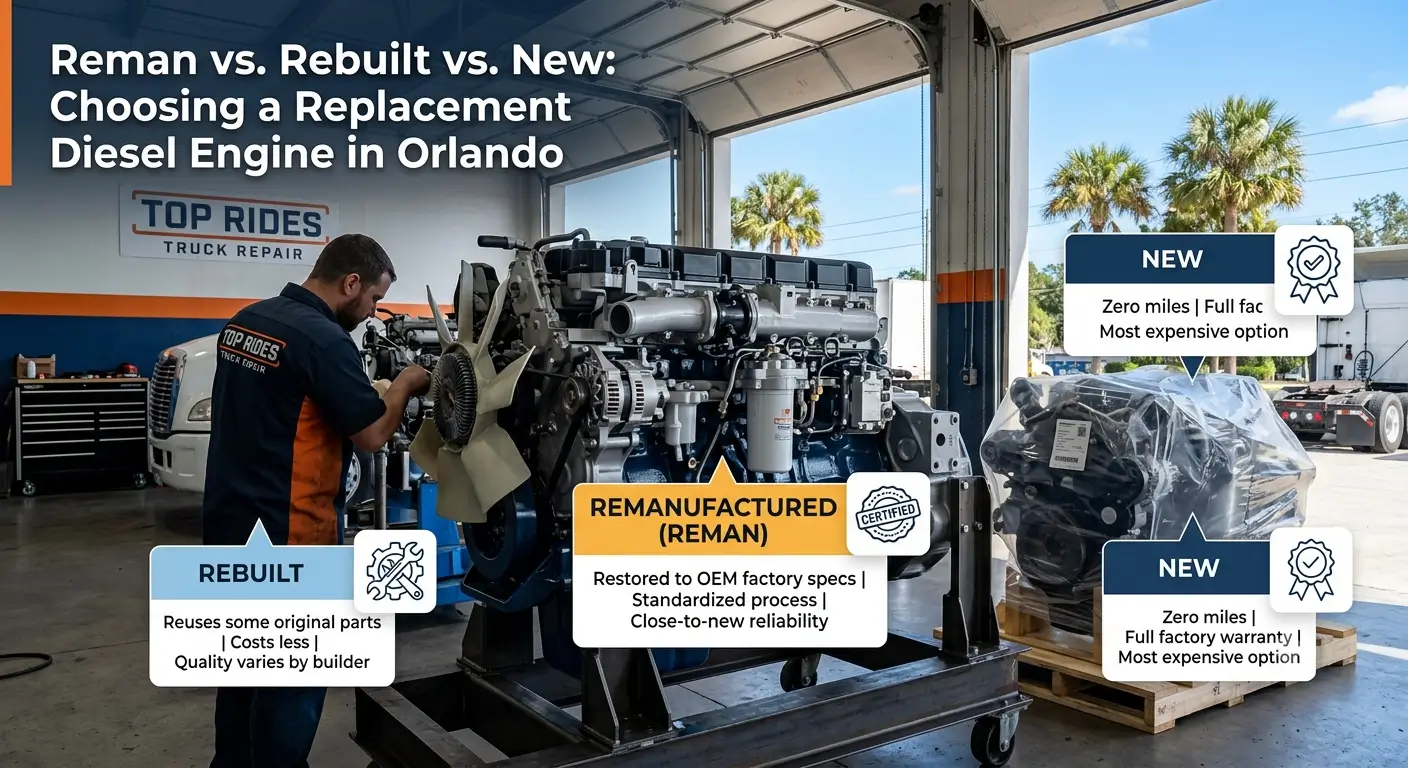
Rebuilt. A rebuilt engine gets torn down, cleaned, inspected, and the worn or broken parts get replaced. The catch is in what happens to the parts that aren’t obviously worn. If a component still falls inside the manufacturer’s wear limits, it usually goes back in. So you end up with a mix: some brand-new parts, some original parts with plenty of miles already on them. Quality depends heavily on who did the work and how honest they were about borderline parts.
Remanufactured (reman). A reman engine is taken all the way down to bare components and brought back to the original manufacturer’s specs, on a standardized production process. Wear parts get replaced across the board, and everything is machined and measured against factory tolerances rather than “good enough” limits. The result is closer to a new engine than a rebuild is. Industry groups define remanufacturing as an industrial process that restores worn products to like-new condition, and for diesel engines that means a much tighter, more consistent result than a one-off rebuild. You can read the formal definition of remanufacturing here if you want the standard behind the word.
New. A crate engine straight from the OEM, zero miles, full factory warranty. Nothing was reused, nothing was borderline. It’s also the most expensive path by a wide margin, and for a lot of trucks it’s more engine than the situation calls for.
The comparison table
Here’s the short version, the way we’d sketch it out for you at the counter.
| Factor | Rebuilt | Remanufactured | New |
|---|---|---|---|
| What’s replaced | Worn/broken parts only; in-spec parts reused | All wear parts replaced, machined to OEM spec | Everything; factory-fresh |
| Consistency | Varies by builder | Standardized process, repeatable | Highest |
| Relative cost | Lowest | Middle | Highest |
| Typical warranty | Shortest, builder-dependent | Strong, often multi-year | Longest, full OEM |
| Expected lifespan | Good if done right, but variable | Close to new | Longest |
| Downtime | Can be quick if done in-shop | Depends on unit availability | Depends on OEM stock |
| Best when | Budget is tight and the core is solid | You want near-new reliability without new-engine price | Truck is newer and worth the full investment |
Treat the cost and warranty columns as relative, not fixed numbers. Pricing swings with your engine family, core availability, and what shape your old block is in. The point of the table isn’t the exact dollar figure, it’s the tradeoff pattern: rebuilt saves money and risks consistency, new buys certainty and costs the most, reman sits in the middle and is where a lot of working trucks land.
How to actually decide
The right answer depends less on the engine and more on the truck around it.
How many miles and years are left in the rest of the rig? Dropping a new OEM engine into a truck with a tired transmission, worn rears, and a rusting frame is money you won’t get back. If the truck has real life left, the investment makes sense. If it doesn’t, a rebuilt or reman keeps you running without overspending on a chassis you’ll retire soon.
What’s your downtime tolerance? A truck sitting in a bay isn’t earning. Sometimes the fastest available option wins even if it isn’t the cheapest, because two extra weeks off the road costs more than the price gap. We talk about that downtime math in our breakdown of whether a semi truck engine is worth repairing at all.
What does the warranty really cover? Read it. A cheap rebuild with a 90-day warranty can cost more over a year than a reman with real coverage. Ask what’s covered, for how long, and whether labor is included.
Who’s doing the work? This is the one people skip. A rebuild is only as good as the shop that did it, because the whole thing hinges on honest judgment about borderline parts. That’s exactly where a shop that focuses on diesel beats a general operation, and it’s a big reason owner-operators keep moving from dealer service to local diesel shops.
One more thing worth knowing before you commit: Orlando is harder on diesel engines than most places. The heat and the stop-and-go on I-4 push cooling and aftertreatment systems constantly, which is why trucks running out of Orlando wear faster than the same truck running a cooler lane. Whatever engine you put in, the Florida climate is going to test it, so the cooling system and the install quality matter as much as the engine choice itself.
What we’d tell you at the counter
Most of the time, for a working truck that’s got good bones but a dead or dying engine, reman is the sweet spot. You get close-to-new reliability without paying new-engine prices, and the standardized process takes the guesswork out that makes rebuilds a gamble. Rebuilt earns its place when the budget is tight and the core is genuinely solid. New makes sense when the truck is newer and worth the full commitment.
But that’s the general case, and your truck isn’t the general case. Before we’d point you anywhere, we’d look at your actual engine, your core, the rest of the rig, and how you run it. If you want to see how the raw numbers shake out on a full rebuild, we lay that out in what it costs to rebuild a semi truck engine in Orlando.
Diesel engine replacement in Orlando
Top Rides is a semi truck repair shop at 9640 Sidney Hayes Rd, Orlando, FL 32824, a few minutes off the Beachline and the Turnpike. We do full in-frames, engine swaps, reman installs, and new-engine replacements on Cummins, Detroit, PACCAR, Volvo, and Mack, and we run the OEM diagnostic software for each. We serve owner-operators and fleets across Central Florida, including Kissimmee, Apopka, Sanford, Winter Garden, St. Cloud, Ocoee, Lake Nona, and along I-4, SR-528, and Florida’s Turnpike.
Every job gets a flat-rate quote in writing before any wrench turns, so you’re comparing real numbers, not guesses. If you’re weighing reman versus rebuilt versus new on your truck, call (407) 591-6747 or email contact@topridesrepair.com and we’ll walk you through what actually fits your rig and your budget.
FAQ
Is a remanufactured diesel engine as good as new?
Close. A reman engine is brought back to the original manufacturer’s specs with all wear parts replaced on a standardized process, so it’s far more consistent than a rebuild and much cheaper than a new crate engine. For most working trucks it’s the best balance of reliability and cost.
What’s the difference between rebuilt and remanufactured?
A rebuild replaces the parts that are worn or broken and reuses parts that still fall within wear limits, so quality varies by builder. A reman takes the engine fully down and restores every wear component to factory tolerances on a repeatable process. Reman is more consistent; rebuilt is usually cheaper.
Should I put a new engine in an older truck?
Usually not, unless the rest of the rig has real life left. Dropping a full-price new engine into a truck with a worn transmission, tired rears, or a rusting frame rarely pays off. A rebuilt or reman keeps you running without overspending on a chassis you’ll retire soon.
How long does a diesel engine replacement take in Orlando?
It depends on the option and parts availability. An in-shop rebuild can move quickly; reman and new installs depend on unit stock. We give you a realistic timeline with your written quote before we start.
Do you install customer-supplied engines?
Call us and ask about your specific engine. We’ll tell you straight whether it’s a fit and what the install involves. (407) 591-6747.