
Published by Top Rides Truck Repair, 9640 Sidney Hayes Rd, Orlando, FL 32824. Call (407) 591-6747. Written by the shop floor team and reviewed by our ASE-certified heavy-duty technicians.
Short answer: all three are good systems, and the brand on the console is not what decides whether your alignment holds. What decides it is the reference line the shop measures against, how many axles they actually put sensors on, and whether they can fix what they find. A shop running the most expensive rack in the county can still hand you a steer-toe-only alignment that does nothing for your tire wear. We run Hunter. We will still tell you that a good tech on a Josam beats a lazy one on our equipment.
The question underneath the question
Drivers do not usually walk in asking about equipment brands. They ask a version of this instead: how do I know this shop is going to do it right?
Equipment is a reasonable proxy for that. It is visible, it is expensive, and a shop that spent six figures on an alignment bay is probably serious about alignment. But it is a proxy, not the answer. So this is worth understanding at the level of what the machines actually measure, because that is where the real differences live.
Reference line: the part almost nobody explains
Every alignment answers the question “straight compared to what?” The answer is the reference line, and there are three of them in use.
Geometric centerline draws a line through the middle of the axles. Fine on a passenger car. On a tractor with tandems it can hide a lot.
Thrust line uses the direction the drive axles are actually pushing. Better, and it is what most steer-axle-only work is quietly referencing.
Frame centerline uses the chassis rails themselves as the reference. This is the one that matters on a Class 8 truck, because a tractor that has been in service for 600,000 miles may not have a frame that agrees with its axles anymore. If you set the steer axle square to the drives, and the drives are not square to the frame, the truck still dog tracks and the steers still scrub.
That distinction, not the logo, is the thing to ask a shop about.
What all three systems measure
The shared list is longer than most drivers expect. Any of these three, used properly on a multi-axle setup, will give you caster, camber, and toe on the steer axle, steering axis inclination, thrust angle, tandem axle parallelism and scrub, axle offset and setback, and toe out on turns. All three produce a printed before-and-after report.
If a shop cannot hand you that report, the equipment question is moot. You did not get an alignment. You got a toe adjustment.
Hunter
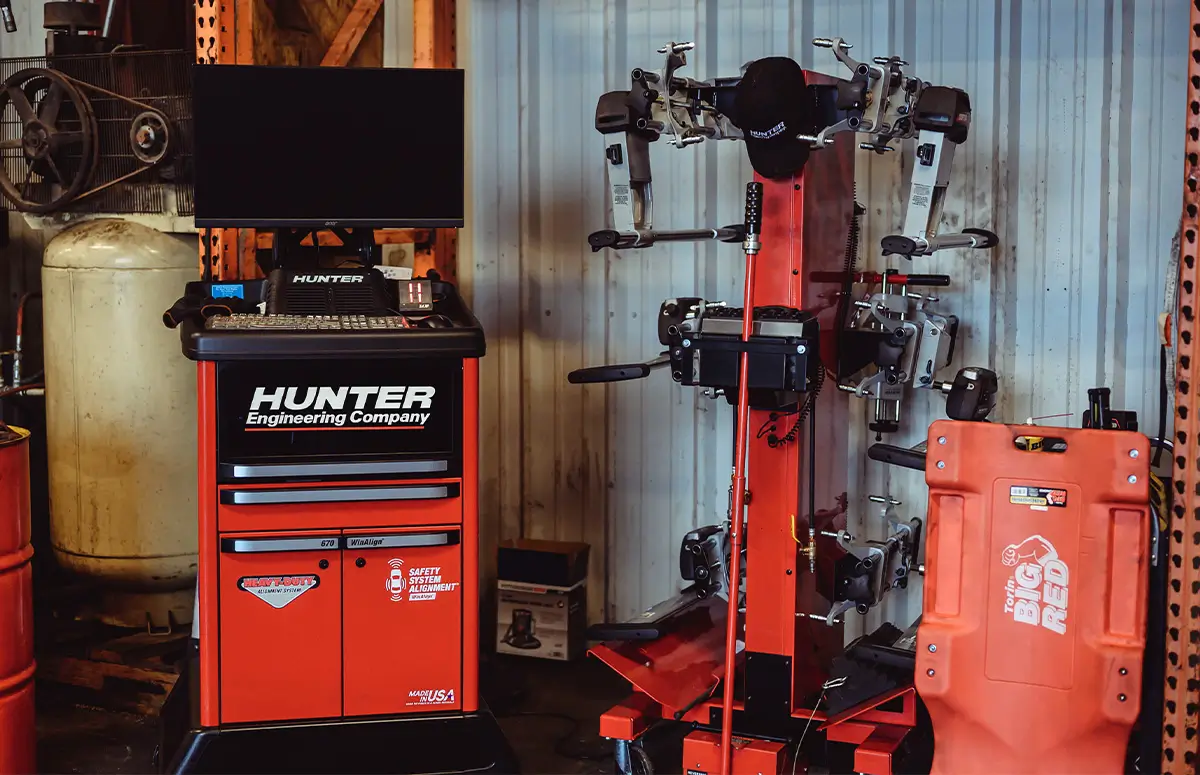
Hunter’s heavy-duty line, WinAlign HD and HawkEye XL, uses electronic sensors clamped to the wheels. Six sensors, all live at once, so a tech sees three axles simultaneously rather than working an axle at a time.
The design priority is speed. Rolling compensation means no jacking each axle to compensate the sensors, and Hunter publishes three-axle readings in about three minutes of measurement time on its WinAlign HD product page. Trailers can be measured without unhooking from the tractor, and the sensor accuracy extends to 600 inches, which covers any tractor-trailer combination on the road. The software carries more than 60 truck, trailer, and bus axle configurations.
On the reference-line question, Hunter handles it through a frame offset angle measurement that calculates adjustments back to frame centerline when a frame reference alignment is called for.
Where it is strongest: high-volume shops that need throughput without giving up multi-axle accuracy. Where it is weaker: it measures and it guides adjustment, but the correction of a genuinely bent chassis is a separate job on separate equipment.
Bee Line
Bee Line comes at this from the frame side. The company builds both laser alignment gauging and frame correction presses, and frame centerline reference is the core of how they teach the work. Their marketing language for it is Total Vehicle Wheel Alignment, meaning every angle rather than toe and tracking.
The gauging is laser-based rather than sensor-based, with heads that span long distances for tractor-trailer measurement, and the systems are operator-calibratable in the bay rather than requiring a service call.
The real Bee Line differentiator is that a shop with a full setup can correct what it measures. Their frame press does cold correction of sags, sway, twist, and diamond without heat, so the rail keeps its original tensile strength. If a truck has actual frame damage from a wreck or years of overload, that capability is the thing you want, and no amount of measuring accuracy substitutes for it.
Where it is strongest: heavy collision work, chassis correction, and shops that see structurally damaged trucks. Where it is weaker: a full frame machine takes floor space and capital most general repair shops cannot justify.
Josam
Josam is Swedish, now under Snap-on, and it shows up more in Europe than in American shops. The two products worth knowing are Laser AM and Cam-aligner.
Laser AM is manual and laser-based. A projector mounts to a wheel adapter and targets measuring scales set out from the centerline. It is the low-cost entry into real heavy-vehicle geometry, and because it does not need a fixed bay, it works for mobile operations.
Cam-aligner is the camera-based system, and it references chassis centerline directly. It measures by rolling rather than by jacking, handles two axles in one rolling sequence, and compensates for floor unevenness, which means it will give valid readings on a surface that is not dead level. That last part is a bigger deal than it sounds. It also carries OEM approvals from several truck manufacturers, and Volvo has approved its static ADAS calibration procedure.
Where it is strongest: shops working on uneven floors or in the field, and shops doing ADAS calibration on newer trucks. Where it is weaker: parts, service, and trained technicians are harder to find in the US than for either American brand.
So where do the real differences show up?
Not in accuracy. All three, calibrated and used correctly, will resolve toe and camber far finer than any adjustment you can physically make on a truck axle. Arguing about which is more precise is arguing about the wrong thing.
The differences show up in four places.
Throughput. Hunter is built around minimizing setup time. If a shop is running trucks through all day, that compounds.
Correction capability. Bee Line’s frame press does something the other two do not attempt. If your problem is a bent chassis, gauging alone will only tell you how bad it is.
Floor and field flexibility. Josam Cam-aligner compensating for an uneven surface is genuinely useful. Hunter and Bee Line both want a proper bay.
Calibration discipline. This is the one that actually bites. Any of these systems drifts out of calibration if nobody calibrates it. Bee Line and Josam both build in operator self-calibration. Ask a shop when they last did it. The answer tells you more than the brand.
What we run, and why we are not going to pretend it is the only right answer
We run Hunter heavy-duty on a four-post lift. We chose it for throughput and because parts and service support in Central Florida are good, which matters when a machine goes down and you have trucks in the lot.
That is a business decision about our shop, not a verdict on the other two. If you brought us a tractor with a visibly damaged frame, the honest answer is that a full Bee Line frame correction shop is better set up for that specific job than we are, and we would tell you so. What we will not do is measure your steer axle, adjust toe, and call it a truck alignment in Orlando.
What ruins an alignment regardless of brand
Worn parts. A loose kingpin or a shot tie rod end means the geometry will not stay where you put it, and no equipment on earth fixes that. This is why our pre-alignment inspection covers kingpin play, tie rod ends, drag link, and spring pack condition before anything goes on the rack. If we find play, you get a quote before we adjust anything. Sometimes that turns into suspension repair first.
Skipping axles. A steer-only alignment on a tractor with misaligned tandems is money spent on a symptom.
Ignoring the trailer. Tractors and trailers can each be square on their own and still fight each other. Trailer alignment is a separate measurement.
Bad tires already on the truck. Cupped or scrubbed rubber affects how the truck behaves after you align it. Worth reading our breakdown of common tire wear patterns if you are trying to work out whether you need alignment, tire service, or both.
Five questions to ask any alignment shop
Ask what reference line they use for a tractor. If the answer is vague, keep looking.
Ask how many axles get sensors. On a three-axle tractor the answer should be all of them.
Ask when the equipment was last calibrated.
Ask whether you get a printed before-and-after report. Insist on it.
Ask what happens if they find worn parts mid-job. You want to hear that they stop and quote you, not that they adjust around it.
None of those questions mention a brand. That is the point. We wrote more about evaluating shops generally in our guide to picking a truck repair shop in Orlando.
Pricing and where we are
Alignment pricing at our Orlando shop, so you have something concrete to compare against:
- Front-end alignment, steer axle only: starting around $189
- Full tractor alignment, three axle: starting around $389
- Trailer alignment: starting around $249
- Fleet pricing on five or more trucks: call for a quote
Pre-alignment inspection is free. A front-end alignment takes roughly 1.5 to 2 hours, a full three-axle 3 to 4. Most go out the same day.
We are on Sidney Hayes Rd in south Orlando, off the 417 and minutes from the Turnpike. Drivers and fleets come to us from Kissimmee, Apopka, Sanford, Winter Garden, St. Cloud, Ocoee, and across Orange County.
Top Rides Truck Repair 9640 Sidney Hayes Rd, Orlando, FL 32824 (407) 591-6747 Monday through Friday, 8:00 AM to 6:00 PM
Running a fleet? Alignment checks fit naturally into a preventive maintenance schedule, and our multi-point inspection process documents what we found and what we set it to. Get in touch for fleet pricing.
Common questions
Is Hunter better than Bee Line or Josam?
For most alignment work, no meaningful difference in the result. Hunter is faster to set up, Bee Line can correct frames as well as measure them, Josam handles uneven floors and has broader OEM ADAS approvals. Pick the shop, not the logo.
Does the equipment brand affect what I pay?
Not much. Pricing tracks how many axles get measured and how long the truck sits, not what machine measured it. A three-axle alignment costs more than a steer alignment on any system.
My shop only has a passenger-car alignment rack. Can they do my truck?
No. Passenger car systems cannot reference frame centerline on a tractor or measure tandem scrub, and most cannot physically fit a Class 8. A free alignment check at a tire shop is not the same service.
How do I know if the equipment is calibrated?
Ask. Shops that stay on top of it will tell you without hesitating, and most modern heavy-duty systems log calibration. If the answer is a shrug, that is your answer.
Do you use laser or camera sensors?
Electronic sensors on Hunter heavy-duty equipment, six of them live at once, on a four-post lift. Every job gets a printed report.