
Published by Top Rides Truck Repair, 9640 Sidney Hayes Rd, Orlando, FL 32824. Call (407) 591-6747. Written by the shop floor team and reviewed by our ASE-certified heavy-duty technicians.
Short answer: storm debris rarely bends anything you can see. What it does is knock caster and toe out by a fraction of a degree on the steer axle, and that fraction is enough to scrub a set of steer tires down to the belts in a few months. Trucks come to us after storm season with clean-looking front ends and ruined rubber. If you ran through debris on I-4, the 417, or the Turnpike this season, get the steer geometry checked before you replace tires, not after.
What actually hits your truck out here
Central Florida storm season does not throw the same stuff at trucks that a northern winter does. Up north the enemy is a frost-heaved pothole. Here it is what the wind puts on the road surface and leaves there.
The things we trace damage back to, in rough order of how often we see them:
- Shredded retread carcasses, the alligators, sitting in the right lane after a squall clears traffic out
- Palm fronds and pine limbs that look soft and are not, especially the butt end of a frond going under a steer tire at 62 mph
- Roofing debris, mostly tile fragments and sheet metal, on the surface streets around Pine Hills and Ocoee
- Standing water hiding an edge drop where the shoulder washed out, which is the one that actually bends things
- Construction cones, barrels, and sign frames blown into travel lanes on the 528 and 417
None of that leaves a dent in a bumper. Most of it leaves nothing at all that a driver would notice on a walkaround. That is exactly why it costs money later.
Why a strike moves geometry instead of just breaking a part
Here is the piece most drivers have backwards. They assume a hit either breaks something or it does not, and if nothing broke, nothing changed.
A steer axle does not work that way. Caster, camber, and toe are held by a stack of parts that all have some compliance built in: kingpin bushings, tie rod ends, the drag link, the spring pack and its bushings, the axle beam itself. A hard lateral shock does not have to fracture any of that to change the resting position of the stack. It only has to move a bushing inside its own clearance and let it settle somewhere new.
So the tie rod is not bent. The kingpin is not loose enough to fail a DOT check. The axle is not visibly out. And your toe is off by two-tenths of a degree, which nobody can see and every mile can feel.
That is also why a visual inspection clears a truck that a laser rack condemns. Two different questions being asked.
The delay is the expensive part
The thing about a small toe error is that it does not announce itself. There is no pull, no shimmy, no crooked wheel. The truck drives fine.
What happens instead is that the steer tires start dragging sideways a tiny amount every revolution. You lose tread from one shoulder. By the time a driver notices, usually at a PM or when somebody points at the inside edge with a flashlight, the tire has months of scrub on it.
We generally see the gap between the storm and the complaint run somewhere around two to four months. Drivers almost never connect the two events, and I do not blame them. Nothing about running over a palm frond in August feels related to buying steer tires in November.
The regulation side matters too. Under 49 CFR 393.75, a tire with body ply or belt material exposed through the tread or sidewall puts the vehicle out of service, and front tires on a truck or truck tractor need at least 4/32 of an inch of tread depth in a major groove. Scrub wear from a small geometry error reaches both of those thresholds on the shoulder long before the center of the tread looks worn out. Inspectors measure where the tire is worst, not where it is average.
What we check after a storm strike
When a truck comes in for a post-storm truck alignment in Orlando, we do not go straight to the rack. Adjusting geometry on top of a worn part is throwing money away, because the adjustment will not hold.
The pre-alignment inspection covers kingpin play, tie rod ends and the drag link, spring pack and U-bolt condition, shock mounts, and the axle beam for any twist. If we find play, we quote the parts first and tell you what it will cost to do both. Some drivers replace parts now and align now. Some replace parts now and come back. Either is fine. Aligning a truck with a loose kingpin is not.
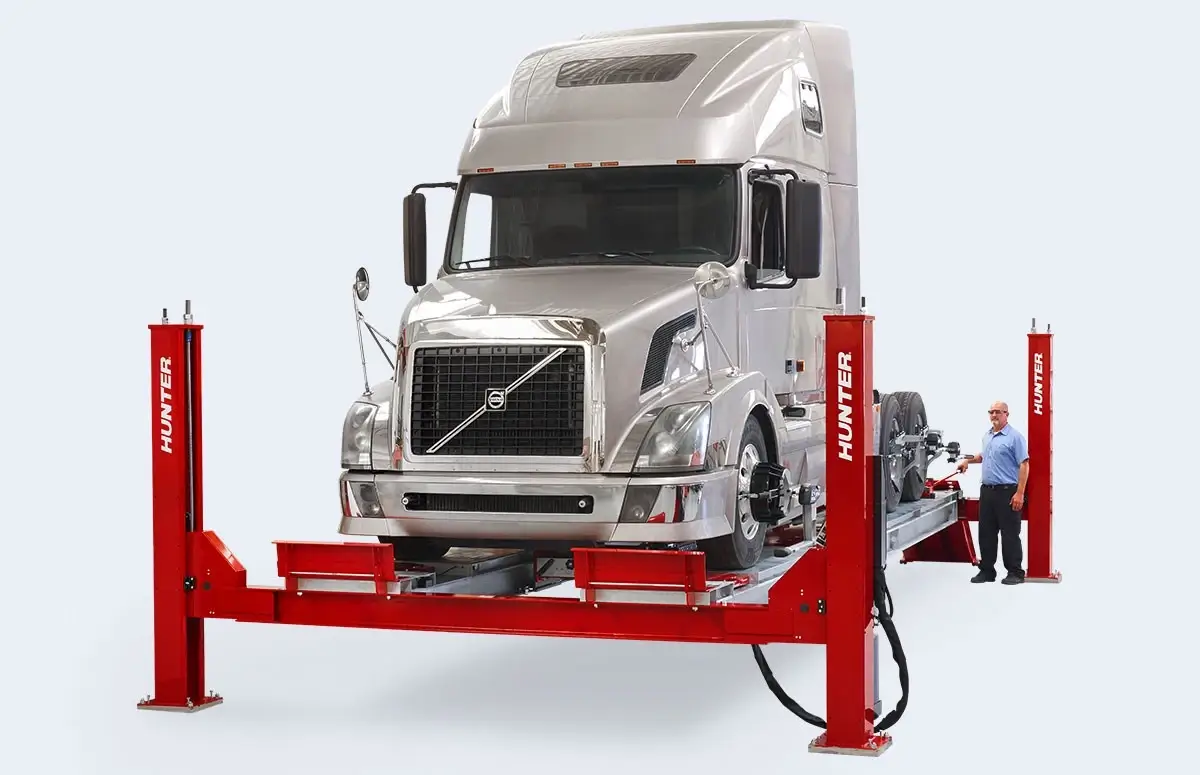
Then it goes on the Hunter heavy-duty four-post lift and we measure caster, camber, toe, and SAI on the steer, plus thrust angle and tandem parallelism on the drives. On a debris-strike truck the interesting number is usually the split between left and right caster. A strike on one side shows up there before it shows up anywhere else.
Related work that often comes out of the same inspection: suspension repair when the spring bushings took the hit, and tire service when the scrubbed steers are past saving. If you are running a trailer that went through the same weather, trailer axle alignment and repair is a separate job and worth doing in the same visit.
Debris strike, pothole, or just wear?
Drivers ask us to tell them which one they are dealing with. Usually we can, from the wear pattern and the caster split.
A debris strike is typically one-sided. One steer tire wears, the caster numbers disagree left to right by more than half a degree, and the driver can often name the week it happened once you ask about it directly.
A pothole or a washed-out shoulder edge tends to hit harder and involve the spring pack or the axle itself. More likely to produce an actual pull, more likely to show up on camber, more likely to need parts.
Ordinary wear is symmetrical and slow. Both steers wear the same way, toe drifts gradually, and the truck has usually gone well past 100,000 miles since its last alignment. Nothing dramatic happened. It just got old.
Cupping and feathering are their own conversation. We wrote about the tire wear patterns we see most often if you want to read the tire side of it. And if your truck sat through a named storm rather than just driving past the debris from one, the post-hurricane inspection checklist covers water intrusion and electrical, which is a different problem entirely.
What it costs in Orlando
Current shop pricing, so you can decide whether this is worth a bay slot:
- Front-end alignment, steer axle only: starting around $189
- Full tractor alignment, three axle: starting around $389
- Trailer alignment: starting around $249
- Fleet pricing on five or more trucks: call for a quote
The pre-alignment inspection is free. If we find worn parts, you get the quote before anything gets adjusted. A front-end alignment runs about 1.5 to 2 hours. A full three-axle takes 3 to 4.
Compare that to a set of steer tires. That math makes itself.
Fleets: build it into the schedule
If you run trucks out of Orange County, the cleanest fix is to stop treating this as a repair and start treating it as a season. Add a steer-axle alignment check to your preventive maintenance schedule for October or November, after the worst of the weather has passed, on every truck that ran Central Florida routes.
It catches the debris-strike trucks before the tires are gone, and it gives you a documented baseline. Our multi-point inspection process writes down what we found and what we set it to, which is useful when you are arguing about tire warranty claims later.
Where we are
We are on Sidney Hayes Rd in south Orlando, off the 417 and a few minutes from the Turnpike. Trucks come to us from Kissimmee, Apopka, Sanford, Winter Garden, St. Cloud, Ocoee, and the rest of Orange County, plus a lot of drivers passing through on Tampa, Jacksonville, and Miami runs.
Most alignments go out the same day. Walk-ins are fine, but call ahead and we will have a bay open when you pull up.
Top Rides Truck Repair 9640 Sidney Hayes Rd, Orlando, FL 32824 (407) 591-6747 Monday through Friday, 8:00 AM to 6:00 PM
If you are broken down instead of scheduling, we run 24/7 roadside service. For anything else, get in touch here.
Questions we get about storm damage and alignment
I ran over debris but the truck drives straight. Do I still need an alignment check?
Probably yes, if it was a solid hit. A truck can drive perfectly straight with enough toe error to destroy a set of steer tires. Straight tracking tells you the left and right sides agree with each other. It does not tell you they are both correct.
How long after a storm should I get it checked?
Sooner is cheaper. If you know you took a hit, come in within a few weeks. If you are not sure, wait for your next PM and have us look at the steer tires. Shoulder wear on one side is the tell.
Will insurance cover this?
Alignment on its own is usually not worth a claim. If the strike bent an axle or destroyed tires, that is a different conversation and depends on your policy. We will document what we find either way, which is what an adjuster wants to see.
Can you align my trailer too?
Yes, and trailers take debris hits just like tractors do. Trailer alignment is a separate job from tractor alignment. We can do both in one visit on most trucks.
Do you do mobile alignment?
No. Alignment on a Class 8 truck has to happen in-shop on the four-post lift to get accurate readings. Mobile work we do for other repairs.
What if the alignment does not hold?
Then something is worn and we missed it or you declined the part. Come back. We would rather re-check it than have you buy tires twice.