
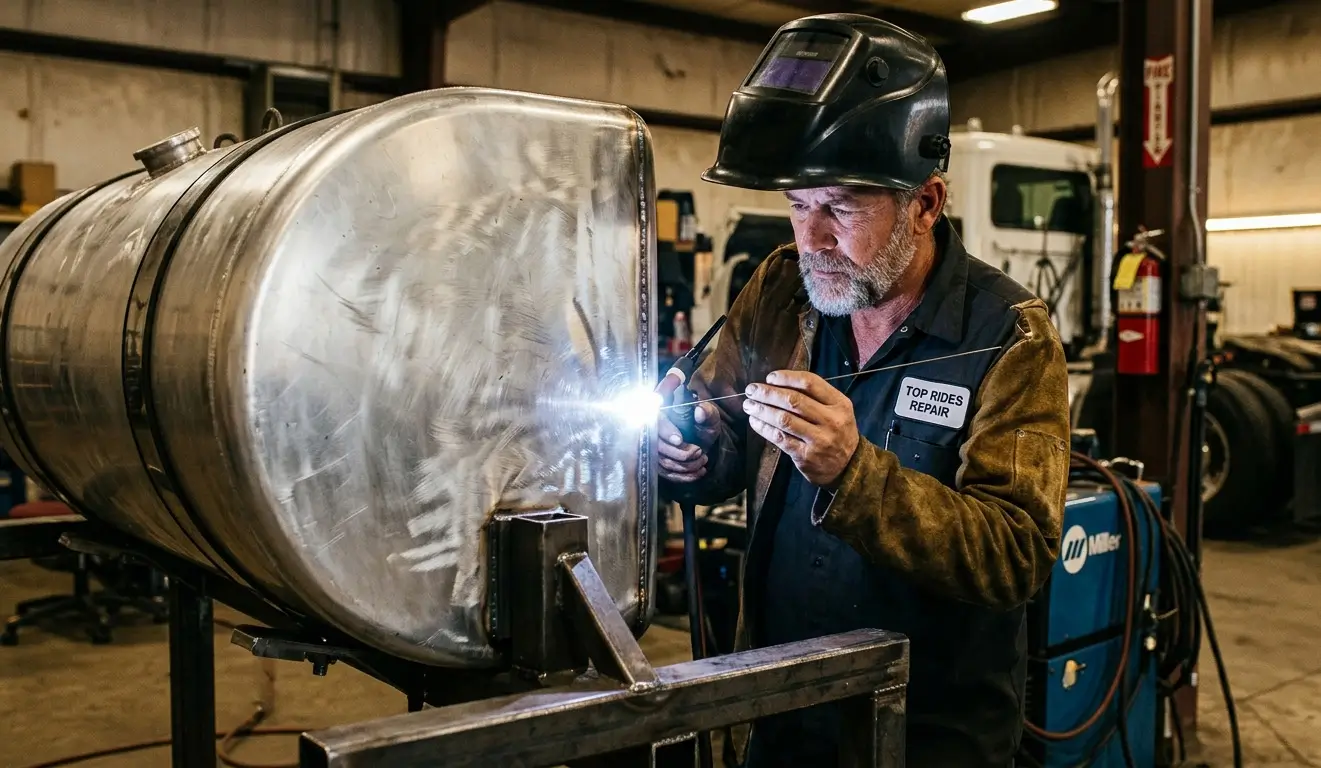
If you’re running a rig, your truck is your livelihood. We get that. We also know that when you spot a leak or a crack in your fuel tank, your first instinct is to get it patched and get back to making miles.
But here’s the cold, hard truth: A fuel tank is a bomb that hasn’t gone off yet.
At Top Rides Repair in Orlando, we’ve seen the “budget” fixes and the DIY patches. We’ve also seen the aftermath when those shortcuts go sideways. Welding a gas tank is the most dangerous job in a diesel shop—period. Here’s why we do things the way we do, and why you should care.
The Danger You Can’t See
You might think a drained tank is a safe tank. It’s not. In fact, a dry tank full of fumes is way more explosive than a tank full of liquid fuel. Those vapors hide in the corners, in the sludge at the bottom, and in the pores of the metal.
If a guy hits that tank with a torch without the right prep, it doesn’t just catch fire—it moves the walls of the shop. That’s why we don’t mess around.
Our “No-BS” Process
We don’t just “eyeball” a repair. We treat every tank like a surgical procedure:
- The Decontamination: We don’t just rinse it out with a hose. we use industrial degreasers and high-heat steam to strip the tank down to its soul. If it doesn’t smell clean, it isn’t ready.
- The Purge: We use gas detectors to sniff out any lingering molecules of trouble. Then, we often flood the tank with inert gas (like Nitrogen) to displace the oxygen. You can’t have an explosion without oxygen.
- The Craft: We don’t just “gob” some metal on there.
- TIG for those finicky aluminum tanks (it’s precise and pretty).
- MIG for the heavy steel tanks that need to withstand the vibration of a thousand miles of highway.
- The Final Exam: Every single tank we weld gets pressure tested. If there’s a leak the size of a needle tip, we’re going to find it in our shop—not while you’re at a truck stop three states away.
Why “Good Enough” Isn’t Good Enough
We’ve all heard the stories of the “old school” way of filling a tank with water or exhaust fumes to weld it. Maybe that worked for some guys back in the day, but at Top Rides, we value your life and our technicians’ lives too much to play those games.
Truth is: A bad weld on a fuel tank doesn’t just lead to a leak; it leads to an environmental fine, a grounded truck, or worse.
Trust the Guys Who Give a Damn
You have enough to worry about on the road—deadlines, traffic, logbooks, and four-wheelers who don’t know how to merge. The integrity of your fuel tank shouldn’t be on that list.
If your tank is weeping, cracked, or just looking rough, bring it to us. We’re in Orlando, we know the heat, and we know exactly what it takes to keep a semi-truck running safe.
Don’t risk a catastrophe to save a couple of bucks. Give Top Rides Repair a call, and let’s do this right.