
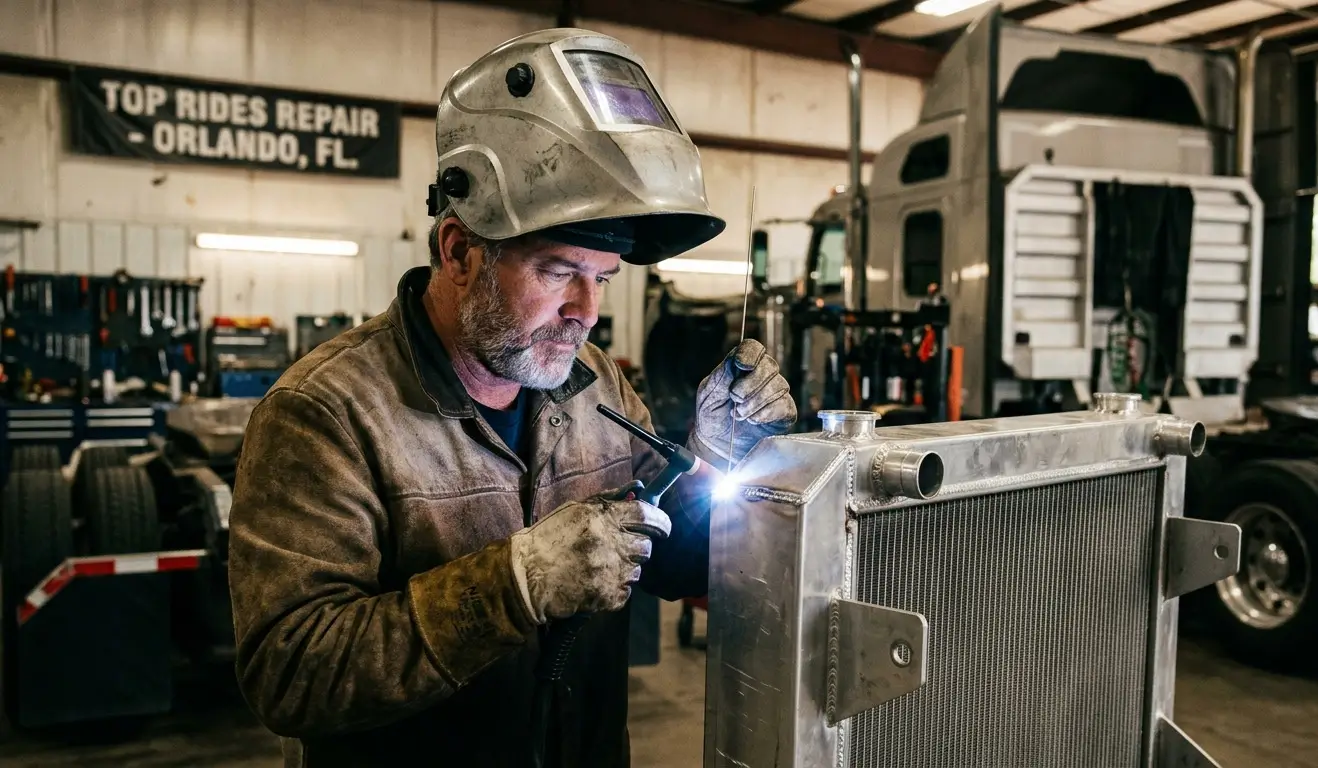
In the trucking world, a leaking radiator isn’t just a “minor annoyance.” It’s the sound of a ticking clock. If you’re sitting on the shoulder of I-4 watching steam roll out from under the hood, you’re not making money—you’re losing it.
At Top Rides Repair, we see a lot of “patch jobs” come through our shop in Orlando. We know the temptation to just slap some JB Weld on a crack and keep rolling, but when you’re hauling 80,000 pounds, you need a fix that actually holds. Here is the reality of how we handle radiator welding the right way, and why the details matter.
Why Semi Radiators Give Up the Ghost
Your radiator is a workhorse, but it’s constantly being bullied by the road. Between the high-pressure environment under the hood and the literal “shakedown” of highway vibrations, things eventually snap. We usually see:
- Stress cracks in aluminum tanks.
- Seam leaks where the metal just can’t take the heat anymore.
- Road debris (because that one rock always finds the most expensive spot to hit).
The Top Rides Process: How We Fix It Right
1. The “Is it worth it?” Inspection
We aren’t here to take your money for a fix that won’t last. The first thing we do is check if the metal is healthy enough to take a weld. If the core is honeycombed with corrosion or “rotten,” we’ll tell you straight up: it’s time for a replacement. A weld on bad metal is just a Band-Aid on a gunshot wound.
2. Prep is 90% of the Battle
You can’t weld through “road grime” and old coolant. We drain, dry, and scrub the area until it’s surgical-grade clean. For aluminum radiators—which most of you are running—we use a dedicated stainless steel brush to strip away oxidation. If you don’t get that “skin” off the metal, the weld won’t stick. Period.
3. Choosing the Right “Weapon”
We don’t just grab a torch and hope for the best.
- Aluminum Radiators: We use TIG (Tungsten Inert Gas) welding. It’s a surgical approach that gives us total control over the heat so we don’t melt your radiator into a puddle of slag.
- Copper-Brass Radiators: These old-school beauties usually require brazing or soldering. Using a high-heat TIG weld here would be like using a sledgehammer to hang a picture frame.
4. The Finesse Phase
Radiator metal is thin. If a technician gets too “happy” with the heat, they’ll warp the tank or blow a hole right through the cooling tubes. We use short, controlled passes, letting the metal breathe and cool down. It takes longer, but it’s the only way to ensure the repair stays structural.
5. The “Moment of Truth” (Pressure Testing)
We never send a truck out based on a visual “looks good to me.” We pressure test every repair. We want to see that weld hold firm under the same stress it’ll face when you’re pulling a grade in 95-degree Florida heat. If it doesn’t sweat during the test, it won’t fail on the road.
The “Don’t Do This” List
If you’re looking at a shop (or doing it yourself), watch out for these red flags:
- Dirty Welding: Trying to weld over grease.
- Over-Torching: Using too much heat and damaging the nearby fins.
- Skipping the Test: Not pressure testing before re-installation.
The Bottom Line
A professional radiator weld can save you thousands compared to a full replacement, and it can add years to the life of your cooling system. But it has to be done with the right gear and a lot of patience.
If you’re noticing your temps creeping up or a sweet smell of coolant in the cab, don’t wait for the “Stop Engine” light. Swing by semi truck repair shop here in Orlando. We’ll give it a look, tell you the truth about whether it can be saved, and get you back under a load as fast as possible.